

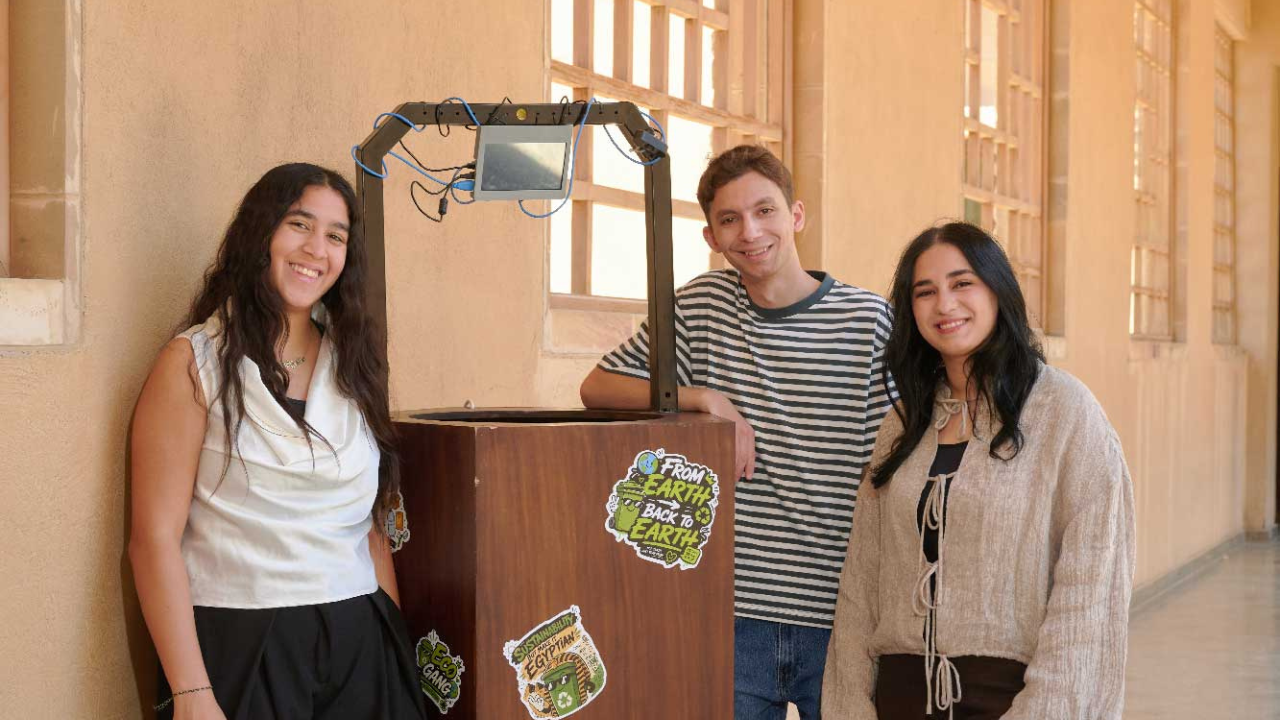
Three AUC data science majors are rethinking recycling with Greeno, an AI-powered smart bin designed for Egypt
What happens when a smart waste bin gets it wrong? For all their ability to identify and sort waste by material, many existing systems still struggle with the realities of what ends up in the recycling stream. Recognizing these gaps, three AUC data science majors set out to develop a smarter waste management solution: an artificial intelligence-powered bin called Greeno, designed specifically for Egyptian waste conditions.
Malak Walaa ’26, Nour Kahky ’26 and Omar Moustafa’26 developed the prototype as part of their data science graduation project.
The students began the project with a broader interest in sustainability and environmental challenges. Rather than limiting their work to existing research, they wanted to understand the realities of waste management beyond the classroom. They studied current technologies, explored the industry and spoke with sustainability professionals at Nestlé, where they began to identify challenges that existing systems often overlook. “It’s only after this conversation that we realized we can do something big and wanted to bring it to life,” Moustafa said.
“An artificial intelligence system is only as reliable as the data it learns from.”
A plastic bottle containing leftover liquid, for example, can contaminate an entire batch of recyclable materials, increasing processing costs and reducing the quality of recycled output. Similarly, everyday items made from multiple materials, such as a paper coffee cup with a plastic lid, can be incorrectly classified because existing systems often identify only the dominant material rather than whether the item can be effectively recycled. “These challenges are critical because they directly affect whether waste can actually be recycled, not just whether it is sorted correctly,” Moustafa said.
The team also explored Egypt’s unique waste management landscape and the role played by the informal sector. Known as the Zabbaleen, Cairo’s informal recyclers have developed a system over generations in which families take on different stages of the process, from collecting and transporting household waste to sorting, processing and recycling materials. In communities such as Manshiyat Naser, waste is brought home and manually separated into materials including plastic, metal, cardboard and fabric, with further sorting and processing carried out by other families.
Understanding this established ecosystem shaped the way the students approached Greeno. As Walaa explained, collectors operate within established territories, and the waste they gather is brought back to their communities for sorting, making a publicly placed smart bin potentially disruptive to an existing network. Instead, the team is targeting controlled environments such as universities, offices and malls, where waste can be sorted before entering the wider recycling chain.
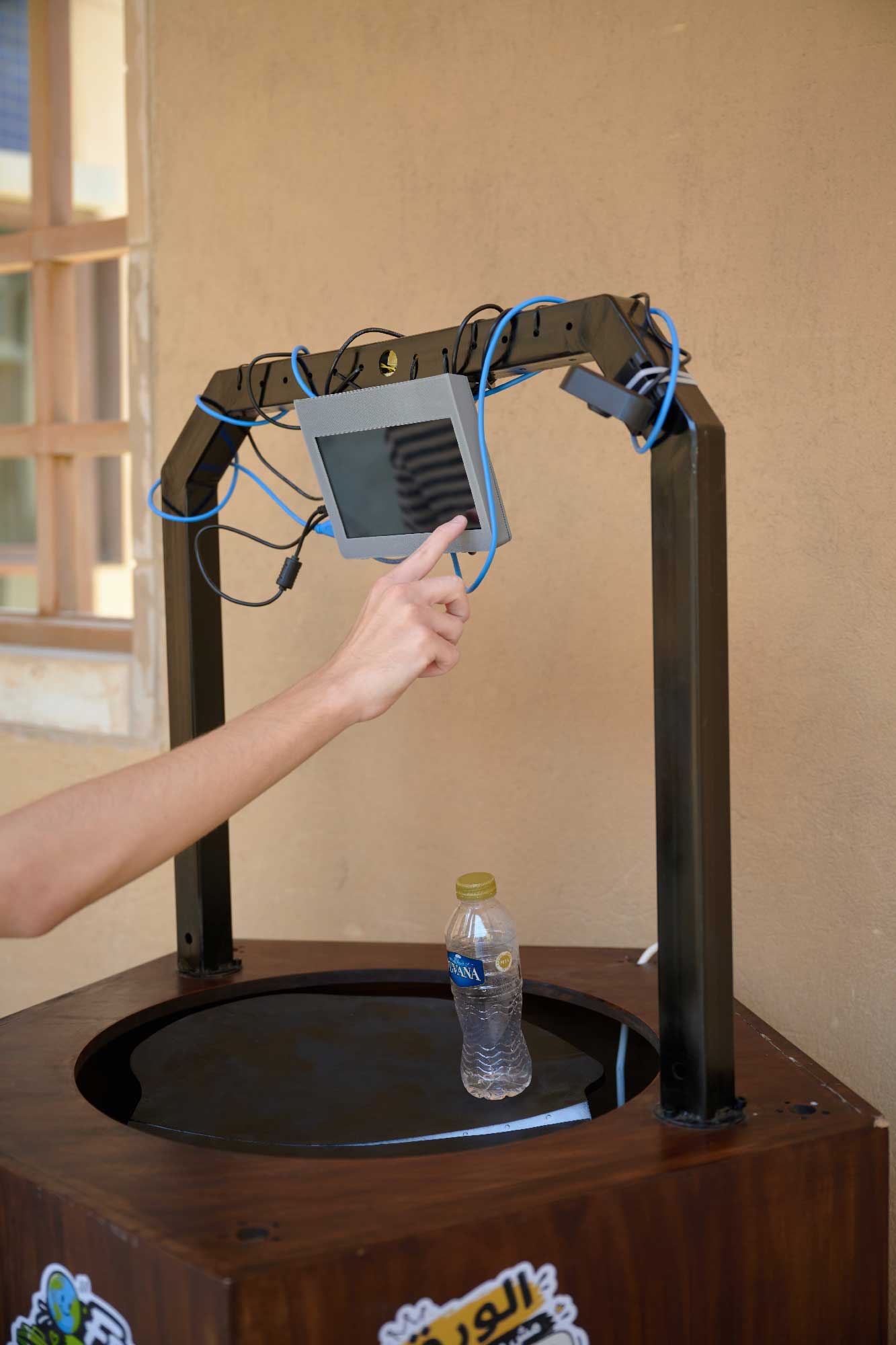
Unlike existing smart bins that primarily classify waste by material, the new system performs multiple checks before sorting an item. A camera captures an image of the waste, then the system identifies liquid and multiple-component items. After these checkpoints, the bin classifies the waste into categories, including recyclable plastic, paper, organic waste, other waste material and non-recyclable waste.
Developing the technology required the students to overcome another major obstacle: creating an AI model adapted to the characteristics of waste found in Egypt. “Existing international waste datasets are usually collected in controlled environments, with clean backgrounds, good lighting and waste items that don’t necessarily represent what we see in Egypt,” Walaa said.
Because Egyptian waste differs in packaging, local brands and disposal habits, the team needed data that reflected the environment where the technology would be used. Through their partnership with Egyptian waste management company Dawar, the students collected images of real Egyptian waste and manually labeled thousands of samples to build their own dataset. According to Walaa, this allowed their models to better understand local conditions, achieving 92.4% external validation accuracy on previously unseen samples of Egyptian waste.
“An artificial intelligence system is only as reliable as the data it learns from,” said Noha Youssef, assistant professor in the Department of Mathematics and Actuarial Science and thesis supervisor. “By testing their system on real waste from Egypt, the students made sure Greeno works where it is actually meant to be used. Technology has to be adapted to our own realities before it can truly serve them.”
“Technology shouldn’t exist just because it’s impressive; it should solve problems that matter to society.”
Without an existing roadmap to follow, the team relied on experimentation, research and mentorship to overcome challenges, spending countless hours refining datasets and retraining models. “There were moments when we felt that this is so much harder than what we expected,” Kahky recalled.
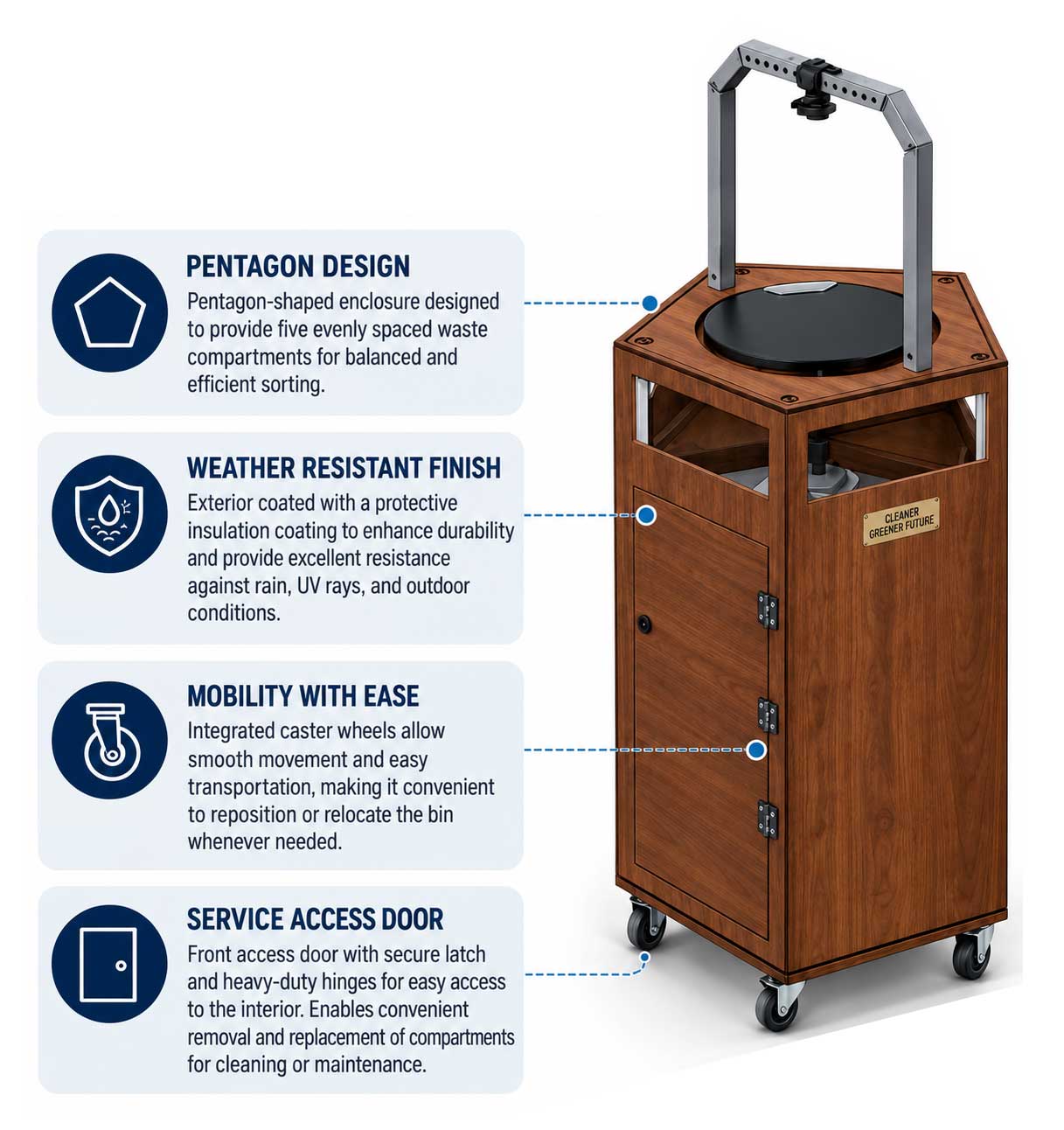
The project’s success ultimately stemmed from its multidisciplinary approach. Students working in artificial intelligence and data science developed the computer vision models, trained the algorithms and created the decision-making system, while mechanical engineering classmates transformed those predictions into a functioning prototype through hardware, sensors and sorting mechanisms.
Industry partnerships were also essential. Dawar provided practical knowledge and access to real-world waste data, while Nestlé’s support helped the students move from an AI model to a physical prototype. At AUC, the Eltoukhy Learning Factory provided the facilities and technical resources needed to design, build and test the system.
“What makes this project stand out is that it did not stop at a model on a laptop,” said Youssef. “Data science students built and trained the models, graduates working at the Eltoukhy Learning Factory turned those predictions into a working bin, and industry partners brought real data and real problems. AUC gave them the mentorship and facilities to bring these pieces together. This is what we hope every student learns: The statistics and machine learning they study in class can become real solutions to problems that matter.”
Every item thrown away carries a question: Could it have been reused, recycled or recovered? By looking
closer at what enters the waste stream, the students hope their system can help make that question less complicated to answer.
While their smart bin is still evolving, the team hopes it can eventually move beyond an academic project and become a scalable waste management solution. “Technology shouldn’t exist just because it’s impressive; it should solve problems that matter to society,” Walaa affirmed.