

When companies pledge to “go green,” are they really committed? The answer is not always yes, according to Sebastian Ille, associate professor of economics.

“We shouldn’t assume markets alone can guide economic actors to behave in the interest of society.”
In his co-authored paper, “Why Do Firms Choose to Greenwash,” published in Macroeconomic Dynamics, Ille argues that firms invest in green production only when economic conditions are more profitable than staying “brown.” Otherwise, they resort to greenwashing, or mimicking sustainability, which is more cost-effective and has been on the rise in recent years, he said.
“The need for profit has always encouraged some firms to behave unethically to gain an edge,” explained Ille. “Highly competitive markets tend to support unethical behavior, especially when information is opaque. We shouldn’t assume markets alone can guide economic actors to behave in the interest of society.”
Markets and Morality
Firms choose to greenwash when appearing sustainable is less costly or more rewarding than authentically investing in green technology, according to Ille.
"The societal costs are substantial: greenwashing constitutes unfair competition and erodes consumer trust, both of which harm genuinely environmentally responsible companies," explained Ille. "Furthermore, it has a long-term effect by impairing the ability of companies and consumers to work toward a more sustainable society."
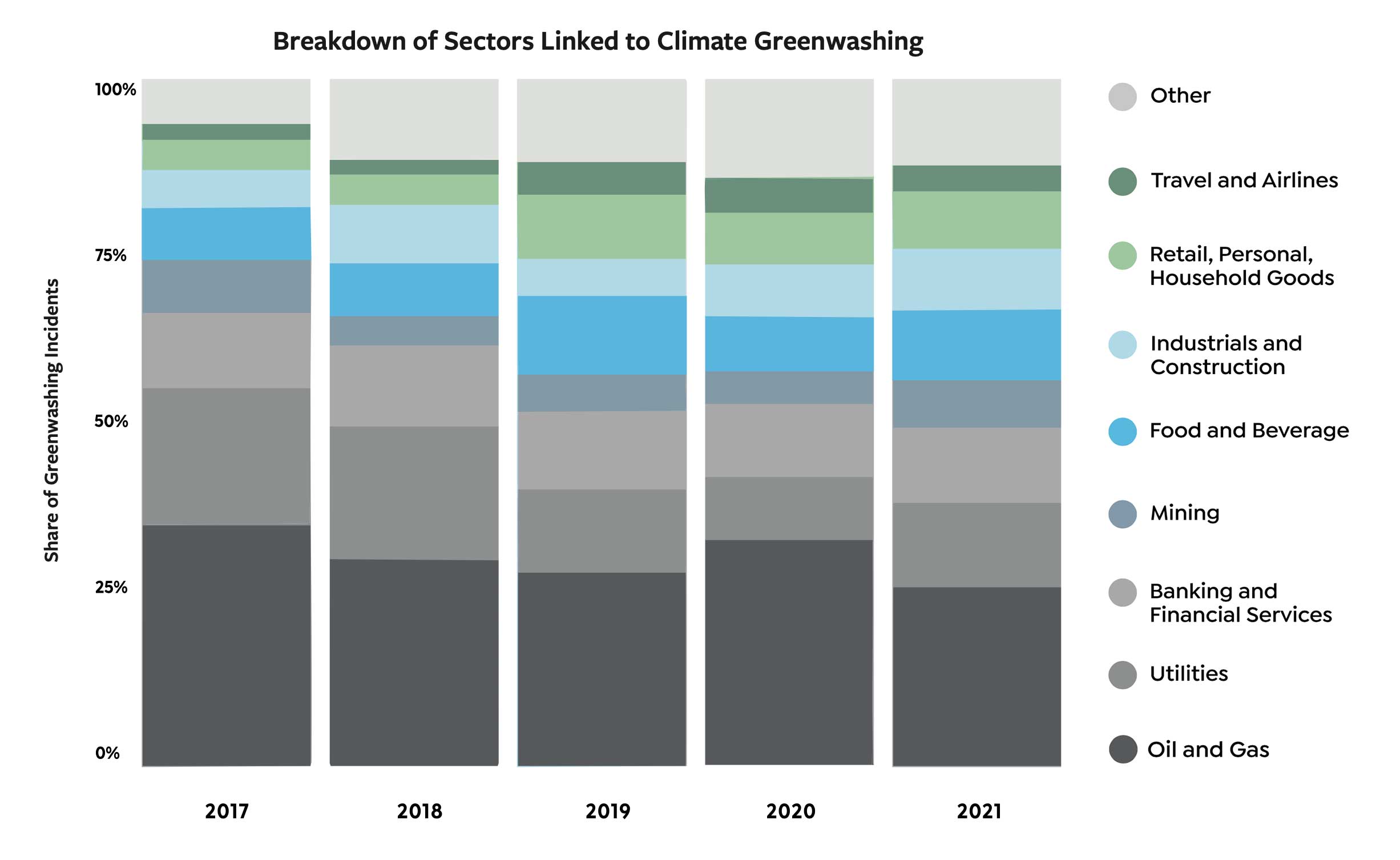
The problem is that when firms greenwash successfully, others follow in their path. This makes it more risky because a higher occurrence of greenwashing increases the likelihood of investigation and detection. This creates a conflict where competition and profit drive firms to greenwash, but they run the risk of damaging their reputation or losing consumer trust.
What Can Be Done
Firms do not simply choose whether or not to become genuinely environmentally sustainable. Instead, accountability depends on a wider network of factors. Consumers, suppliers and regulators all play a role — but only if systems enable them to do so. This requires institutions that increase transparency and enforce standards. Policies such as the United Kingdom’s Green Claims Code are an example, helping define and regulate what counts as a legitimate environmental claim.
At the same time, Ille emphasized that incentives must shift alongside oversight. “In simple terms, the economic benefit of environmental honesty needs to be higher than its cost,” he said.
While sustainable production can be expensive initially, those costs often decrease over time. Greenwashing, by contrast, thrives when the likelihood of being exposed — and penalized — is low. But harsher penalties alone are not a perfect solution. If poorly designed, they may also discourage genuinely sustainable firms.
Instead, he points to more targeted approaches: establishing industry coalitions that distribute costs, increasing peer accountability, creating shared standards and encouraging localized competition. These can be reinforced through tax credits, subsidies and financial policies that ease the burden of transitioning to sustainable practices.
Central banks can also play a role. Through green monetary policy, they can lower the financial cost of environmentally responsible investment, making sustainability not just ethical but also economically viable.
Instead, he points to more targeted approaches: establishing industry coalitions that distribute costs, increasing peer accountability, creating shared standards and encouraging localized competition. These can be reinforced through tax credits, subsidies and financial policies that ease the burden of transitioning to sustainable practices.
Central banks can also play a role. Through green monetary policy, they can lower the financial cost of environmentally responsible investment, making sustainability not just ethical but also economically viable.
Beyond Theory
At the heart of Ille’s research is a dissatisfaction with what he sees as an overly simplified view of human behavior in mainstream economics. Rather than treating individuals as isolated decision makers, he emphasized the role of social interaction in shaping economic life.
This perspective, influenced by economists like Alan Kirman, Herbert Gintis and Samuel Bowles, shifts the focus from individual incentives to collective dynamics. While such approaches are often seen as theoretical, Ille affirms they are essential for understanding why economic policies sometimes fail.
“Admittedly, most policymakers still base their policies on empirical research using historical data. Yet such research often inadequately accounts for the micro-dynamics that drive human behavior, especially when the data is highly aggregated. Policies ignoring that humans interact as part of larger social systems, where beliefs and actions are highly interdependent, often fail to achieve what they intended in the long run,” he said.
This approach directly shapes how Ille models firm behavior in his research on greenwashing. Rather than assuming firms act independently, his model captures how they respond to one another, adapting strategies based on competition, observation and shifting incentives. The result is not just a pattern of firm behavior but a structural constraint. Greenwashing cannot be addressed through penalties and incentives only. Instead, Ille’s research suggests that outcomes depend on the structure of the system itself: how firms interact, what information they have and how easily sustainability can be mimicked.
"In the end, going green is not solely a responsibility of companies but a collective effort shared by businesses, the government and consumers," Ille concluded.
-Additional reporting by Kim Makhlouf