

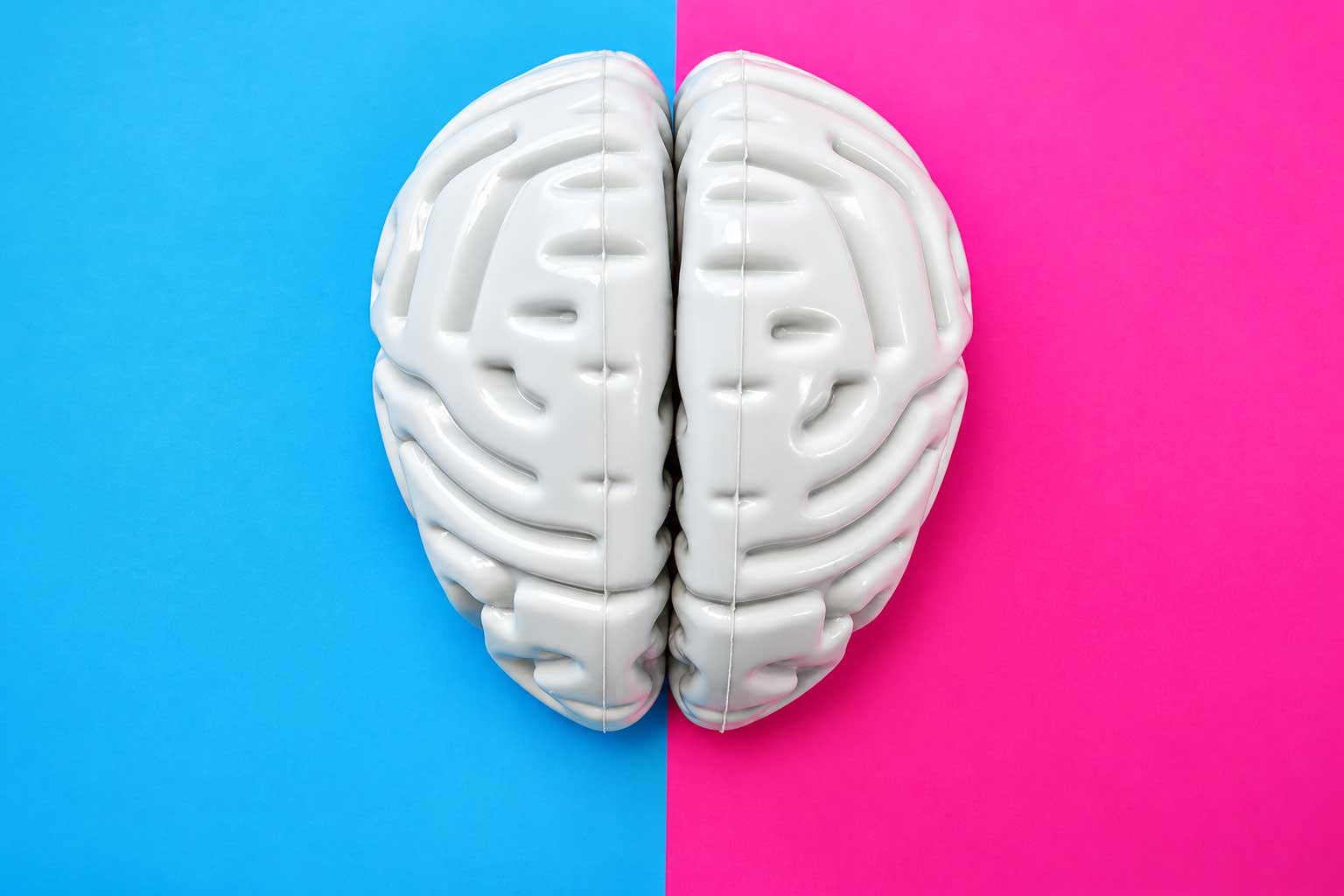
Neuroscientist Mohamed Salama debunks some of the commonly held myths about the difference between male and female brains
The brain is one of the most mysterious parts of the human body, with unique chemistry for each individual. Neuroscientist Mohamed Salama, professor in the Department of Biological, Chemical and Global Health Sciences, debunks some of the commonly held myths about the difference between male and female brains. He argues that many perceived distinctions stem less from neuroscience and more from the ways society shapes our understanding of how different genders interact with the world.
Misconception: Men are better at math and spatial reasoning.
Fact: When discussing brain health, we must understand that these are complex structures unique to each person. Saying that men are naturally better at specific tasks is an oversimplification. There are many women who excel in mathematics and many men who struggle with it. There is no way to validate this statement or predict outcomes using neuroscience as justification. Differences in gender within the mathematics fields are more likely based on gendered societal expectations. In general, societal impact plays a much larger role in our behaviors and even impacts neuroscience, as social exposure affects brain health and structures.
Misconception: Women’s brains are more emotional.
Fact: Part of this misconception comes from the idea that women experience differences in hormone levels that can interact with the brain, but that does not mean they are more or less emotional. Women's brains do go through cycles of hormonal changes, specifically during menopause, which can impact the brain from a disease perspective, but not from an emotional one. For example, women's brains have a higher vulnerability to dementia, which might be caused by the hormonal changes they experience during menopause. Even then, brain science is so complex that a number of factors could be at play, and it's hard to relate this difference to hormones alone. Either way, the influx of hormones in women's brains do not change their emotional responses.
Misconception: Men are more competitive.
Fact: This claim cannot be correlated directly to structural brain differences. It is about social exposure, contextual differences and community beliefs. It would be inaccurate to claim that there is a valid difference between women and men in terms of anatomy or molecular basis. When we are discussing cognition and brain health, it is not only about the anatomical architecture or the structure of neurons. An individual's experiences and circumstances, including their social environment and psychological trauma, can greatly shape the brain.
Misconception: Because of gendered differences in brain chemistry, men and women are suited for different professions.
Fact: This claim is not supported by brain science. Neuroscience is a challenging discipline, but many of the leading figures in the field are women. For a long time, surgery was considered a closed discipline for men only. Today, there are many excellent female surgeons. The barriers for women in male-dominated fields and men in female-dominated fields are societal. While some people might be predisposed toward a certain field, this is not attributed to gender.
Misconception: The brains of men and women are fundamentally different.
Fact: There are no essential differences in the brain structure of men's and women's brains. There are differences in disease risk, which we are still working to understand. While these differences can affect the probability of contracting certain diseases, they do not change personality or how men and women interact with the world around them on an emotional or behavioral level. These differences are caused instead by societal factors and should not be misconstrued as intrinsic to brain chemistry.