

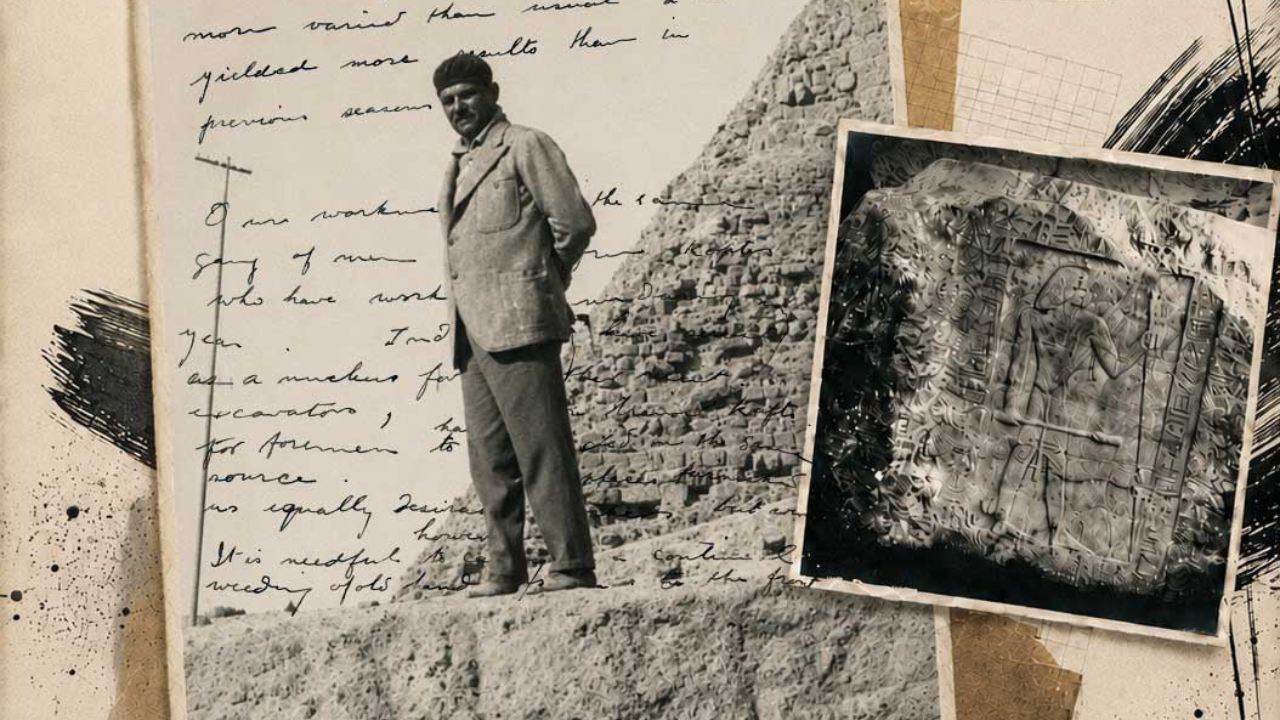
Step into the archives of Selim Bey Hassan, one of the pioneering Egyptian Egyptologists of his time, preserved at AUC’s Rare Books and Special Collections Library
For much of the 20th century, Egyptology was a field overwhelmingly shaped by scholars from outside Egypt. Titans such as Howard Carter dominated the landscape, while Egyptian researchers, excavators and curators rarely led their own expeditions, buried under the systematic barriers to enter the field. Selim Bey Hassan, scholar and excavator of the Giza Plateau, stood as the equal of the European and North American archaeologists of his time. His archives, which have been part of AUC’s Rare Books and Special Collections Library (RBSCL) since 1980, reveal the impact of an Egyptian scholar who documented and interpreted Egypt's ancient past.
“The archive gives us a vivid picture of Selim Bey Hassan in the field,” shared Amr Omar, assistant director for Middle East and Egyptology Collections at RBSCL. “The photos and personal notes reveal the excavation as it actually unfolded: the daily decisions, the unexpected discoveries and the practical challenges of working on one of the most famous and closely watched archaeological sites on Earth.”
“Hassan’s national significance is clear. He is a public embodiment of the possibility that Egyptians could excavate their own ancient past with scholarly competence and institutional authority.”
Hassan’s excavations, which took place between 1929 and 1939 for Cairo University, uncovered the Old Kingdom tombs on the Giza Plateau in remarkable detail. Buried under centuries of sand, these tombs reveal the final resting places of royal family members, high-court officials and elites who formed Egypt’s complex social fabric 4,000 years ago.
An Egyptian Egyptologist
In the 1920s, Egypt was becoming the center of an emerging field of Egyptology largely dominated by foreigners. Western archaeologists flooded the Valley of the Kings, seeking discoveries that would bring fame, prestige and wealth. While many Egyptian scholars, workers, inspectors and intellectuals were certainly present in archaeology, often indispensably, their work received little recognition, Omar noted. Foreign institutions controlled much of the training and publication process, leaving the Egyptians facing an uphill battle, he said.
The greatest splash came in 1922, when Howard Carter found the lost Tomb of King Tutankhamun. The discovery became the biggest archaeological revelation on Egyptian soil in the modern age, shadowed by the fact that it was achieved by a foreigner and interpreted by a body of scholars outside of Egypt.
Instead of one grand discovery — the gold, carriages and gilded sarcophagus famously associated with Carter — Hassan worked slowly and methodically at the Giza Plateau and established a new Egyptian-led path in archaeology. Inscriptions were documented, reliefs were photographed and research was published in volumes that contributed to international Egyptology scholarship. Hassan’s success showed that Egyptians not only had the ability but the right to excavate, understand and interpret their own history. He emerged as an Egyptologist, not assisting a foreign expedition, but leading one for his own people.
“If Carter’s candle illuminated the treasures of Tutankhamun, Hassan’s archive illuminates something no less consequential: the process by which Egyptians began to claim the authority to excavate, document and interpret their ancient past on their own terms,” Omar said. “That is not a minor chapter in the history of Egyptian archaeology. It is an epic story.”
Exploring the AUC Collection
AUC hosts Hassan’s collection, including
10 volumes covering his excavations in Giza and his 16-volume Encyclopedia of Ancient Egypt in Arabic. Lecture notes, drafts of official reports, Giza and Saqqara excavation records, and countless photographs fill the archive. His personal library was also gifted to the University: 2,500 volumes and journals in German, English, French, Arabic and Japanese. It was the first Egyptology collection the library ever received, marking the beginning of AUC’s now extensive cache.
“A thorough reading of Selim Bey’s archives reveals far more than the papers of an individual scholar,” Omar explained. “It shows how his knowledge was formed, how his excavations were organized, how his publications were produced and how his career intersected with one of the decisive moments in the long history of Egyptian Egyptology.”
Pouring over the collection, scholars encounter time-worn pages covered in Hassan’s handwriting, sepia portraits of his team and photographs of the vast Giza complex. The collection has been used by researchers at AUC as well as universities around the world interested in Hassan’s prolific impact. As the Giza Plateau continues to change, these nearly century-old documents connect the past with the present.
“Hassan’s national significance is clear,” Omar affirmed. “He is a public embodiment of the possibility that Egyptians could excavate their own ancient past with scholarly competence and institutional authority. He did not merely stand beside Carter as a parallel figure. He changed the terms of comparison by showing that Egyptian archaeology did not need a heroic discoverer. It needed institutions, records, publications and authority. He made Egyptian-led archaeology visible as a serious, disciplined and internationally legible enterprise.”