

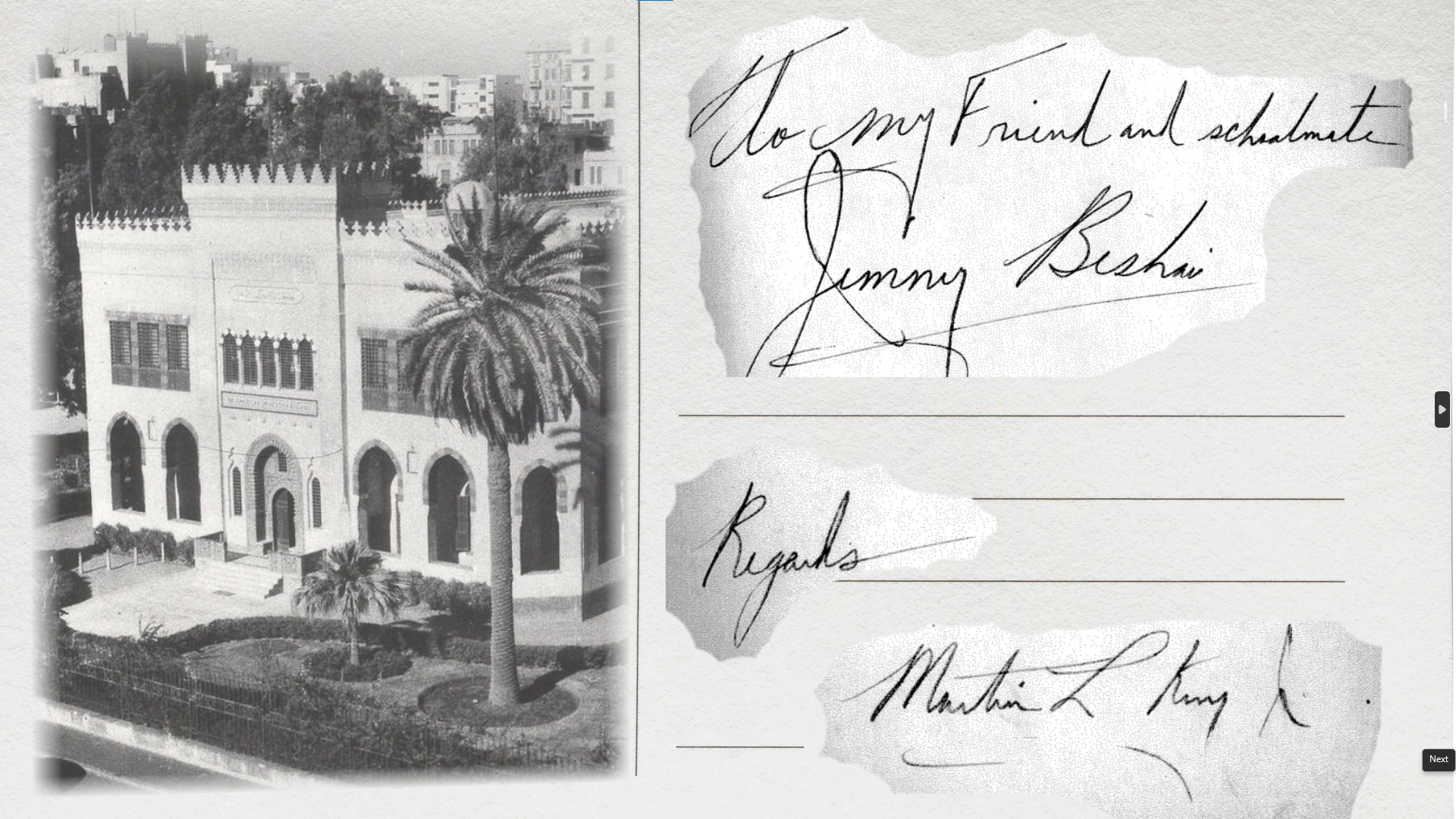
There is little written about Martin Luther King Jr. and Coretta Scott King’s 1959 trip to Egypt. Not only did the civil rights leaders travel to Cairo, but they visited AUC to reunite with one of King’s oldest friends, James Beshai ’47, who served as a psychology instructor at AUC in the 1950s.
Their correspondence is preserved in AUC’s Rare Books and Special Collections Library and AUC: 100 Years, 100 Stories by Andrew Humphreys, tracing a friendship shaped by faith, race and global politics.
"For the many who were lucky as I was to be his friend and classmate, he is the most unforgettable man in my life.”
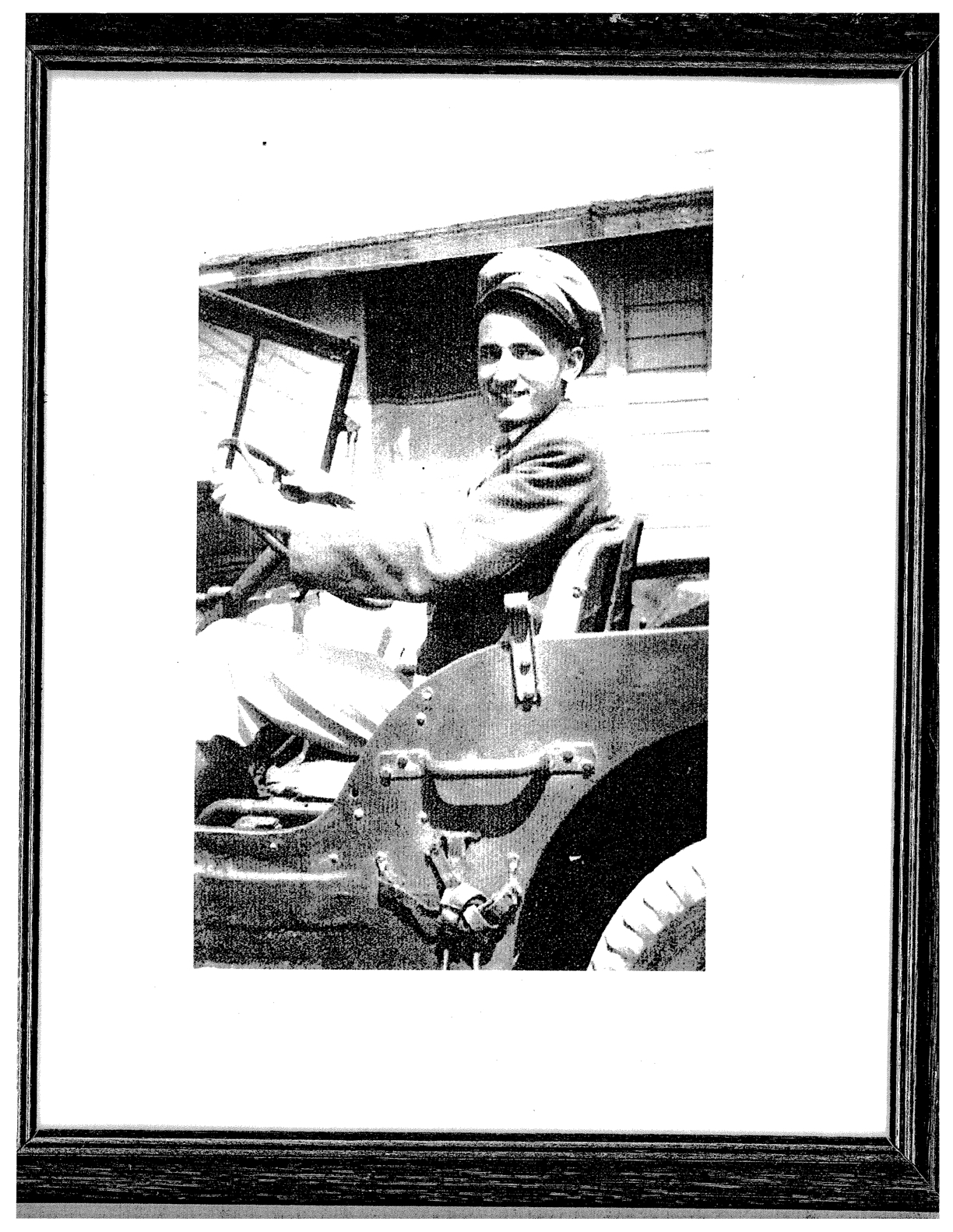
James Beshai as a young man. Photo courtesy of Rare Books and Special Collections Library; American University in Cairo.
Beshai was born on October 18, 1926, in Luxor, Egypt, to a Coptic Christian family. He earned a bachelor’s in social science and psychology from AUC in 1947. In September 1950, he moved to the United States on a two-year Fulbright scholarship to study psychology at the University of Pennsylvania and religion at Crozer Theological Seminary in Chester, Pennsylvania. He settled into a dormitory, where, just down the hall, lived 21–year-old Martin Luther King Jr.
Beshai was one of three international students attending Crozer and overlapped with King from September 1950 to June 1951. The two became friends in an era of systemic racial discrimination against African Americans.
In a 2012 oral interview for the University’s Archives, Beshai recounts King once asking him, “What do you consider yourself to be, a white or Black?”
Beshai responded, “I don’t know because in Egypt they only classify people in terms of religion, you’re either a Christian or Muslim — and color is not part of the image.” King followed up, asking Beshai how he saw King. “And I said, ‘I see you as just a bit darker than I,’” Beshai recalls. “And he said, ‘Shoot man, I’m a Negro.’”
When the dormitories closed for Thanksgiving in November 1950, Beshai was invited to spend the holiday in Georgia with King or in West Virginia with another classmate, William Tasker.
“I chose to go with Bill because he was white. I was aware of what Martin had related to me about his childhood in Atlanta. Martin had related to me at the dinner table how he and his father were treated by a prejudiced white policeman,” Beshai wrote in an essay shared with AUCToday in January 2009.
“I did not feel that I was ready for a visit to Atlanta. I declined the offer and he was gracious to invite me again in his correspondence.”
Beshai later apologized for declining the invitation, and King told him, “Well you have to promise to see me again next year.” The two kept in touch after graduation and King sent word to Beshai that he would visit him in Cairo.
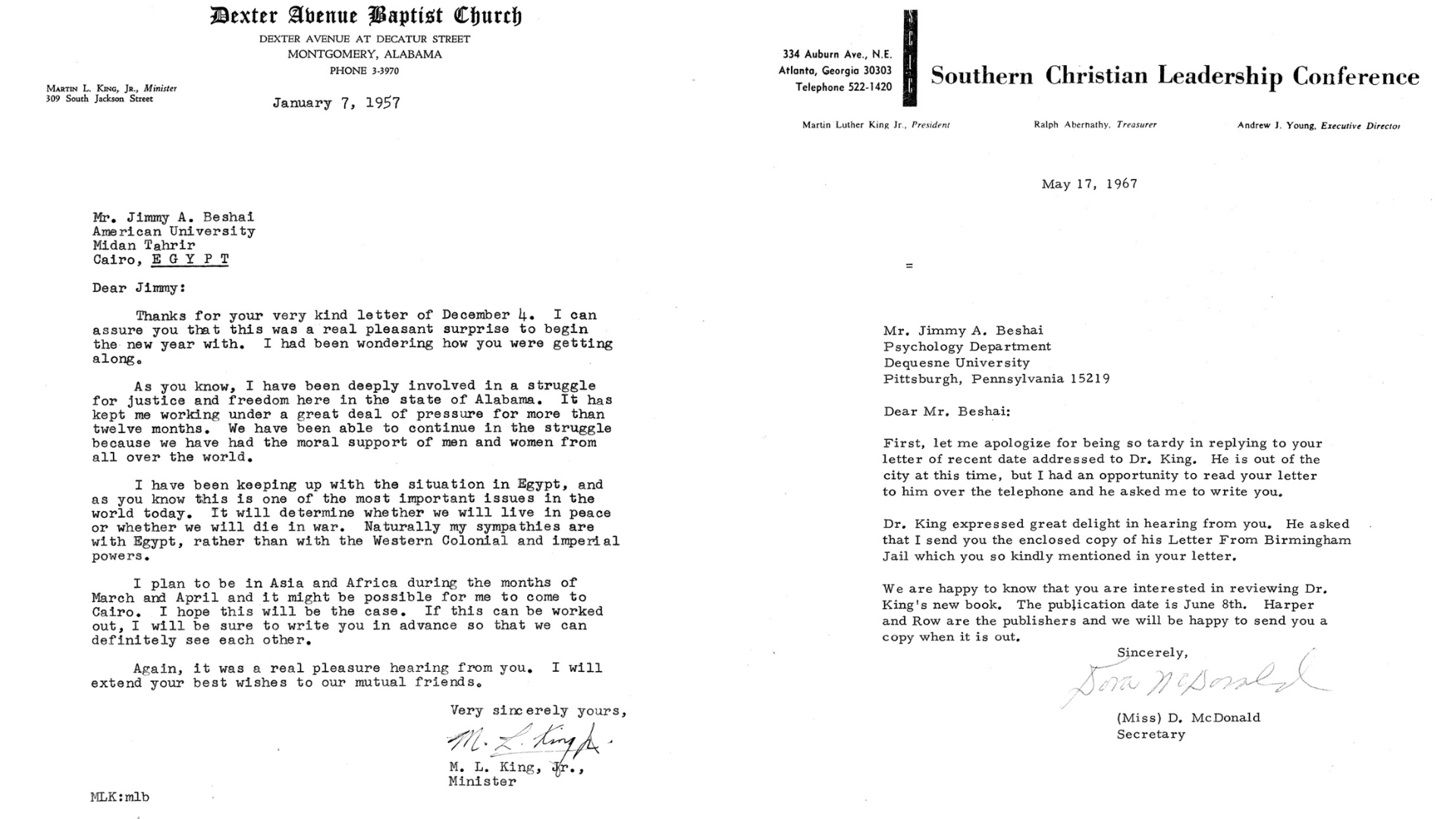
James Beshai and King's friendship lasted well into King's final years, with their correspondences spanning a decade. Photos courtesy of Rare Books and Special
“I plan to be in Asia and Africa during the months of March and April and it might be possible for me to come to Cairo. I hope this will be the case,” King wrote to Beshai on January 7, 1957.
King and Coretta Scott King visited in Spring 1959, an incognito reprieve from work and the violence of the Civil Rights Movement to “enjoy the calm solitude of sunset near the Pyramids,” as Beshai wrote in 2009 for AUCToday.
“He arrived with his charming wife Coretta, spending two days at the Continental Hotel, overlooking the old Cairo Opera. I took him out sightseeing, including a visit to the AUC campus, and a visit to Dar Al-Hilal with the late Emile Samaan ’47, who was editor in chief of the Caravan. I introduced him to Professor Alan Horton, dean of the graduate school, who invited him to address the students in the Wednesday assembly.”
Beshai returned to the United States to pursue a PhD in psychology from the University of Kentucky. King wrote to him in 1961, inviting Beshai once again to visit the South.
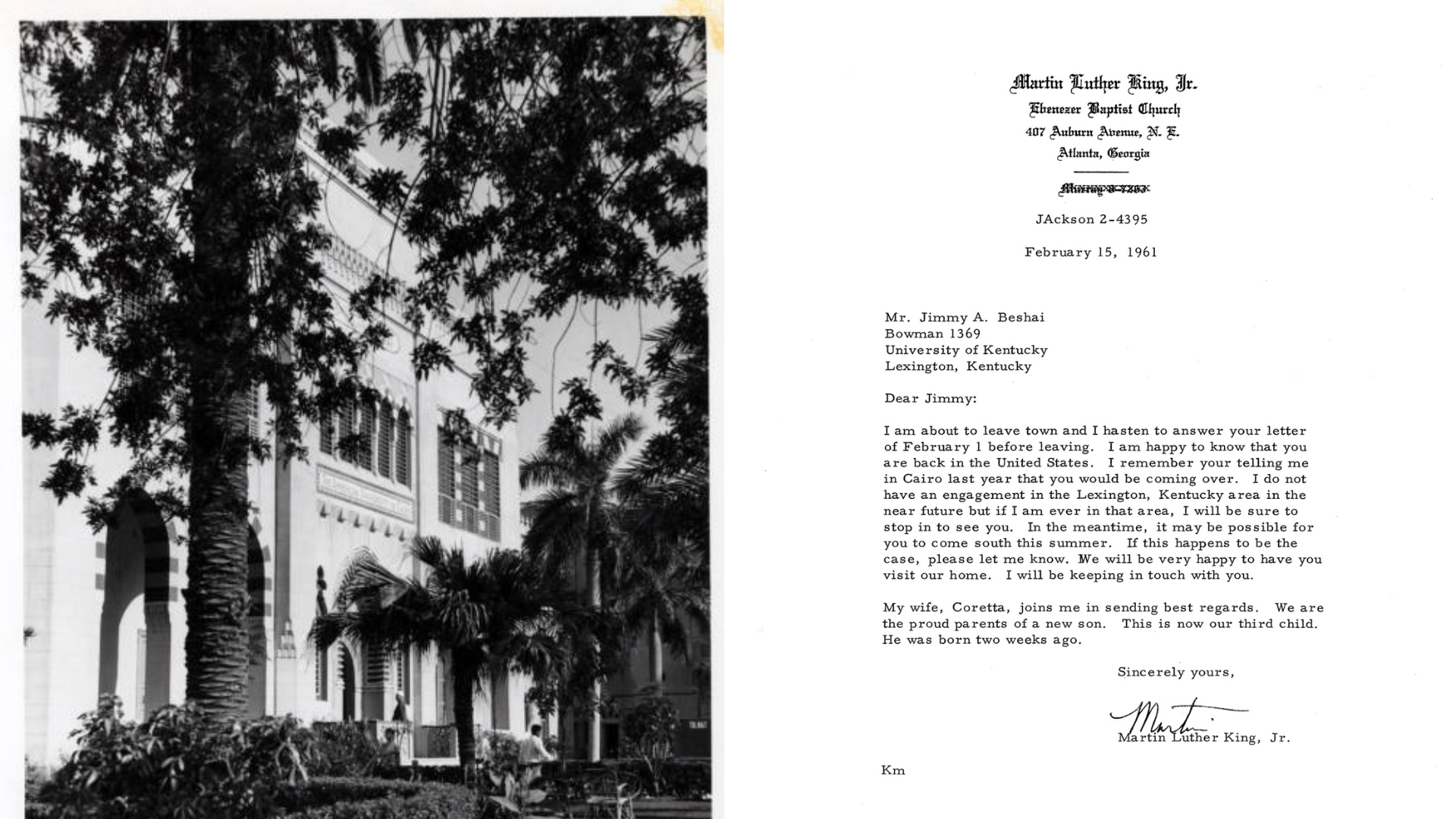
AUC Tahrir dated 1950s to 1960s; Martin Luther King's letter to James Jimmy Beshai '47, dated 1961. Photos courtesy of Rare Books and Special Collections Library; American University in Cairo.
“I do not have an engagement in the Lexington, Kentucky area in the near future, but if I am ever in that area, I will be sure to stop in to see you,” wrote King on February 15, 1961.
“In the meantime, it may be possible for you to come south this summer. If this happens to be the case, please let me know. We will be very happy to have you visit our home. I will be keeping in touch with you. My wife, Coretta, joins me in sending best regards. We are the proud parents of a new son. This is now our third child. He was born two weeks ago.”
The friends last spoke on November 2, 1966, when King visited the University of Pittsburgh to address its student body. Beshai worked nearby as an associate professor of psychology at Duquesne University. King recognized him in the audience and invited him to the stage. “We spent a few minutes chatting, and that was the last time that I saw him,” Beshai wrote in his January 2009 essay.
Martin Luther King Jr. was assassinated two years later, on April 4, 1968. Beshai eulogized King in the May 3, 1968 edition of The Duquesne Duke, and immediately after publication, Beshai said the town police destroyed his car.
“The police were enraged by the article because at that time there was a question of whether the police should all be white or have blacks, and they opposed anyone who tried to promote that idea,” Beshai said in his 2012 oral interview.
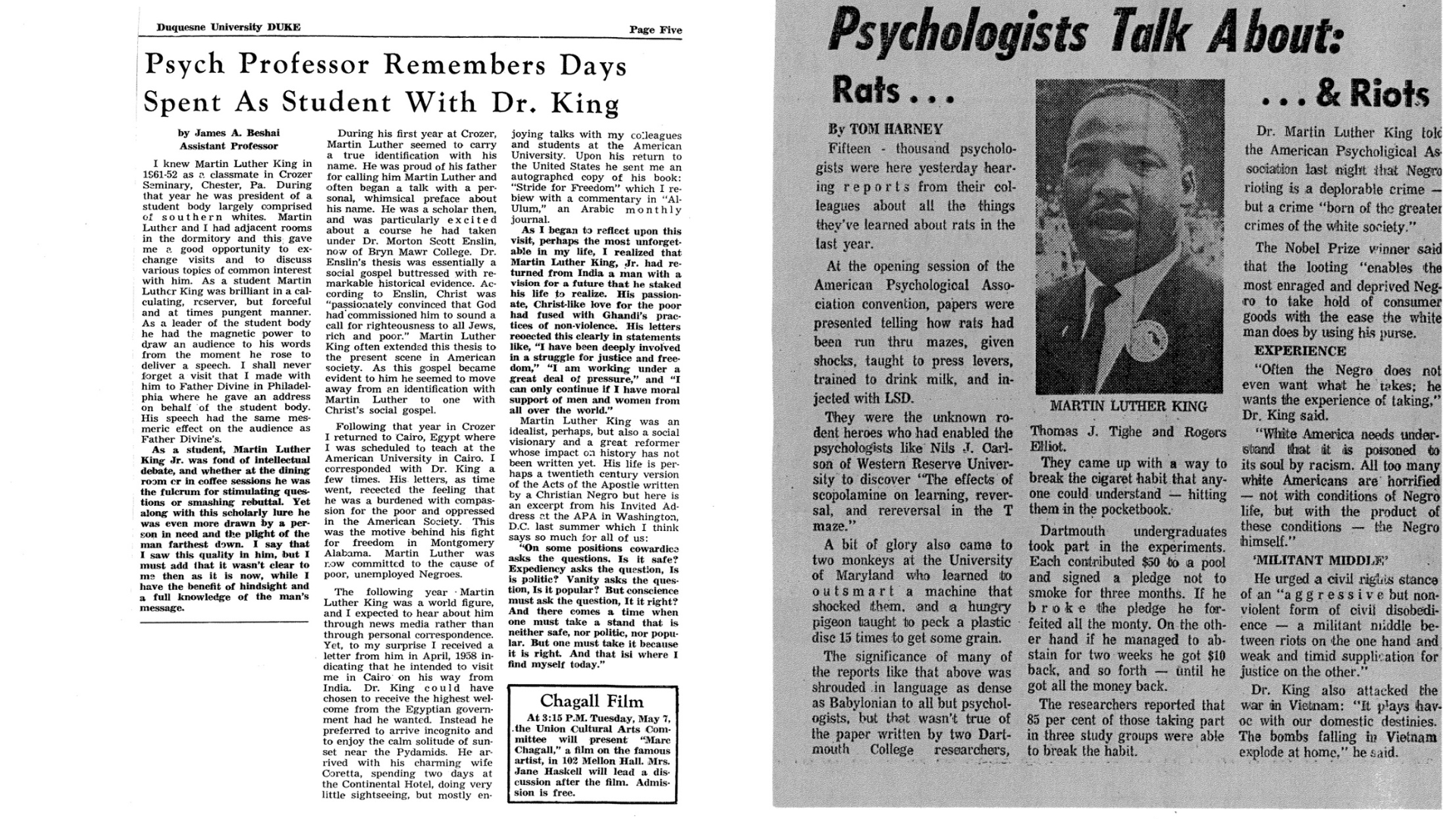
A clipping from Beshai's 1968 eulogy of King in the Duquesne Duke; A newspaper clipping submitted to the archives by Beshai. Photos courtesy of Photo courtesy of Rare Books and Special Collections Library; American University in Cairo.
Beshai later worked as a clinical psychologist at the Veterans Affairs Medical Center in Lebanon, Pennsylvania for 22 years until his retirement. Throughout his life, he continued to eulogize Martin Luther King’s faith and activism. His December 2017 article, “Martin Luther King Jr.—On Love and Justice,” published in The Humanistic Psychologist journal, was dedicated as a personal tribute to King, who would have been 88 at the time of publication. Beshai passed away on November 4, 2024 at 98.
“For the many who were lucky as I was to be his friend and classmate, he is the most unforgettable man in my life,” Beshai wrote for AUCToday in 2009.