

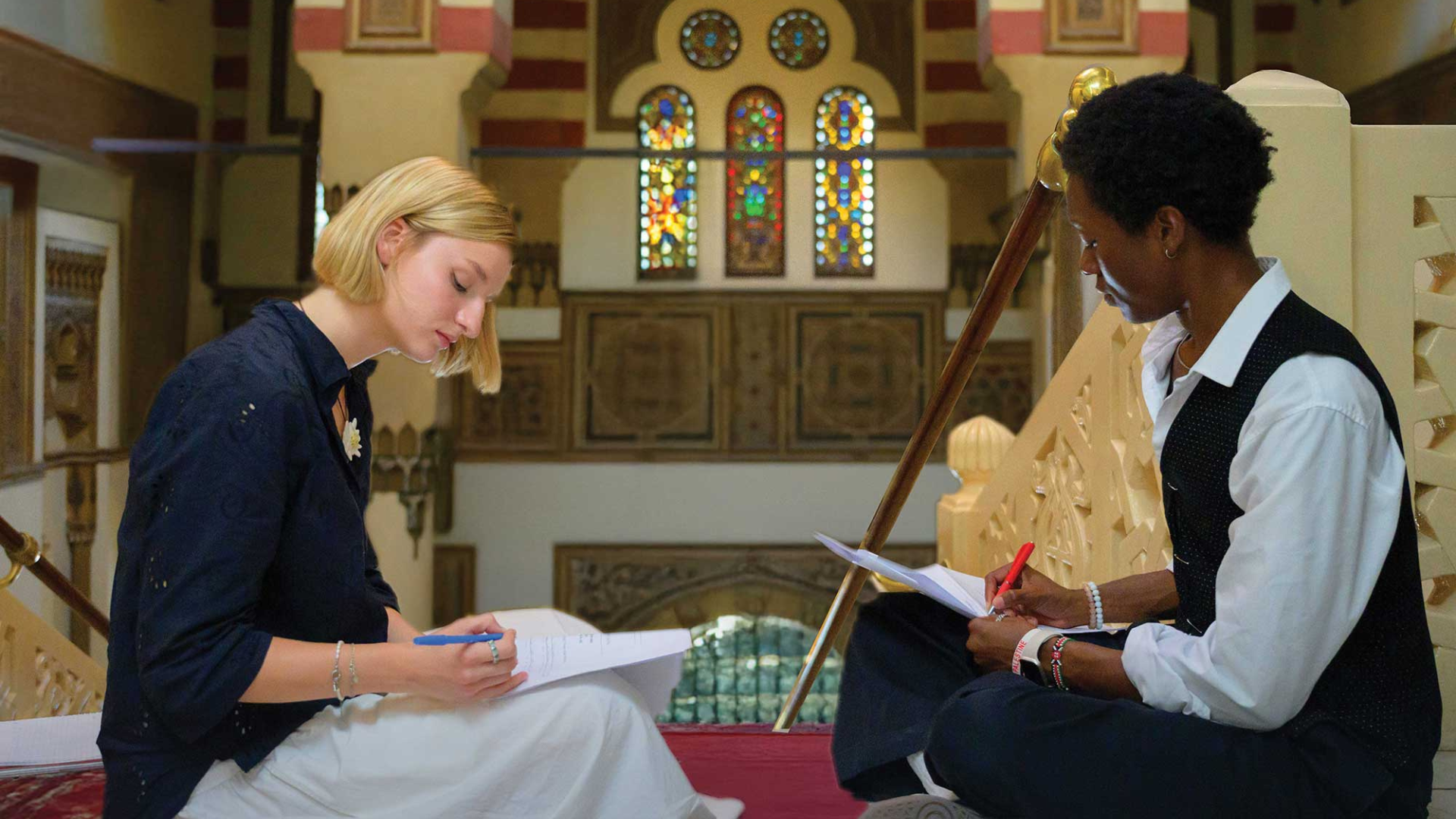
The first time I saw Tahrir, I cried. It was at night, maybe three weeks after I first arrived in Cairo. My friend pointed to her left: “This is the famous Tahrir Square,” then to the right: “This is AUC, our Tahrir campus.” Weeks later, I toured the historic palace for the first time. I was anxious, overwhelmed — the history attached to that plot of land felt vast in a way I couldn’t yet hold.
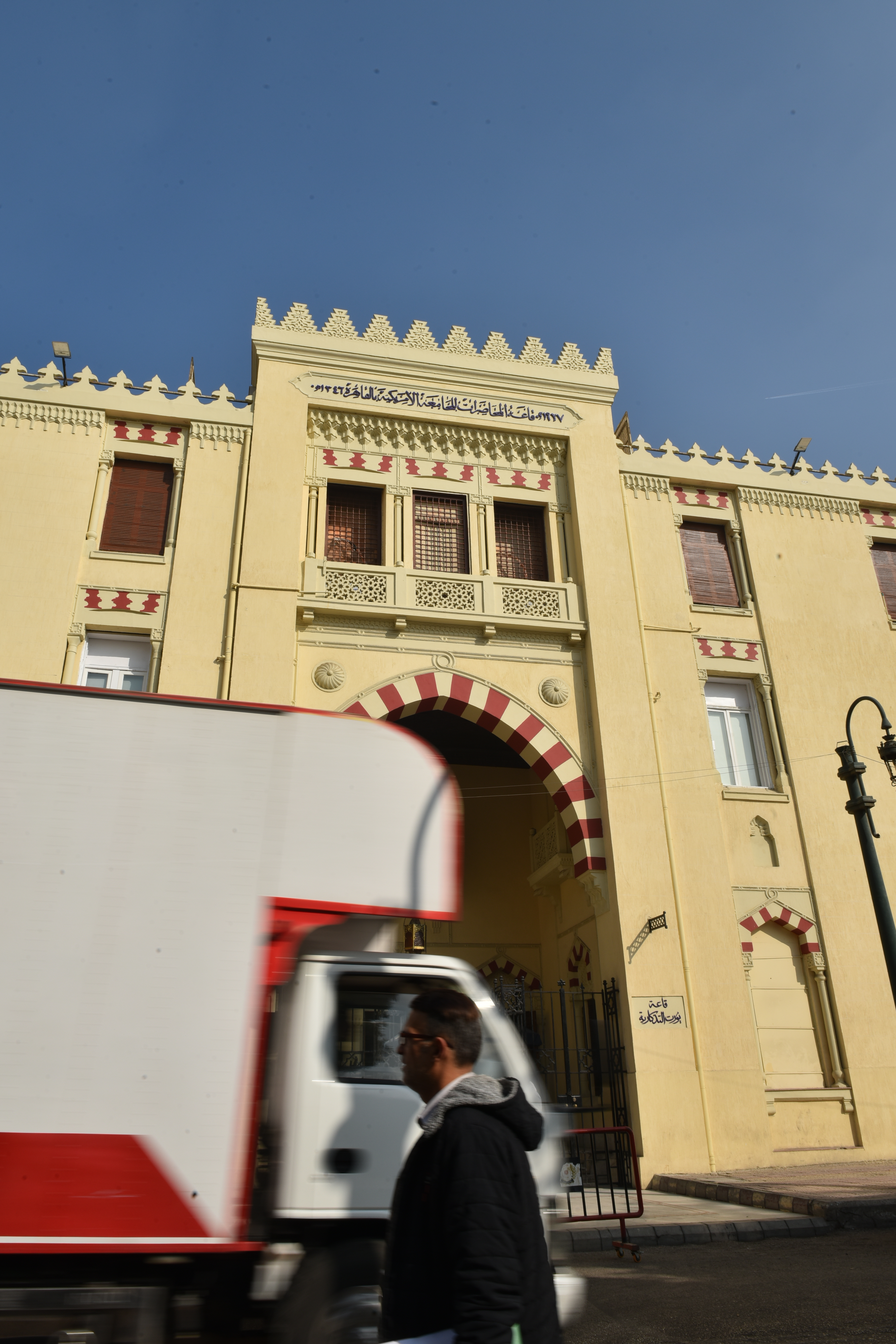
Safa’ Beitawi ’90, executive director of programming at the Tahrir Square campus, guided me through the premises, explaining the purpose of each room and who had walked these halls. Khairy Pasha Palace, built in the 1860s, became AUC’s first home in 1920, welcoming 142 inaugural students. Over the decades, the campus expanded with Ewart Memorial Hall, named after a generous American benefactor, and Oriental Hall — both designed in the neo-Mamluk style that has influenced Cairo architecture for a century. These halls have hosted luminaries including Umm Kulthum, Taha Hussein, diplomats and scholars from around the world.
“AUC didn’t sit beside history; it hosted it,” says Rabab El Mahdi ’96, associate professor of political science and founding director of Alternative Policy Solutions (APS), the think tank on the third floor.
AUC didn’t sit beside history; it hosted it.
The Tahrir Square campus is more than a historical landmark; it is a living classroom. Undergraduate students spend Tuesdays at APS through the Introduction to Development class, combining development theory — a five-week hands-on practicum at Tahrir — and a final reflective project.
“There’s a different energy here than in a classroom,” says El Mahdi. “Students apply concepts to real challenges, working alongside researchers and government stakeholders.”

Students in the Introduction to Development practicum class engage in hands-on policy research
Political science juniors Omar Fahim and Laila Mamdouh describe how the setting shapes their work. “APS talks directly to ministers. It makes me realize our work could reach officials. It motivates me to give my all,” says Fahim. Mamdouh adds, “The aesthetic of the office, with Tahrir Square outside, pushes me into the mindset of doing quality work. It’s not just a class; it feels like a responsibility.”
The practicum is part of AUC’s Tuesdays in Tahrir initiative, a bridge between the New Cairo campus and its historic downtown hub that supports leveraging the Tahrir Square campus for hands-on learning experiences. A pilot features a shuttle service between AUC New Cairo and AUC Tahrir Square, access to classrooms, outdoor seating, galleries and more. As President Ahmad Dallal has described it, AUC is “one University, two campuses,” and initiatives like this allow students to experience the vibrancy of Tahrir. Students walk the grounds, sit in classrooms steeped in history and absorb the rhythm of the city.
The aesthetic of the office, with Tahrir Square outside, pushes me into the mindset of doing quality work. It’s not just a class; it feels like a responsibility.
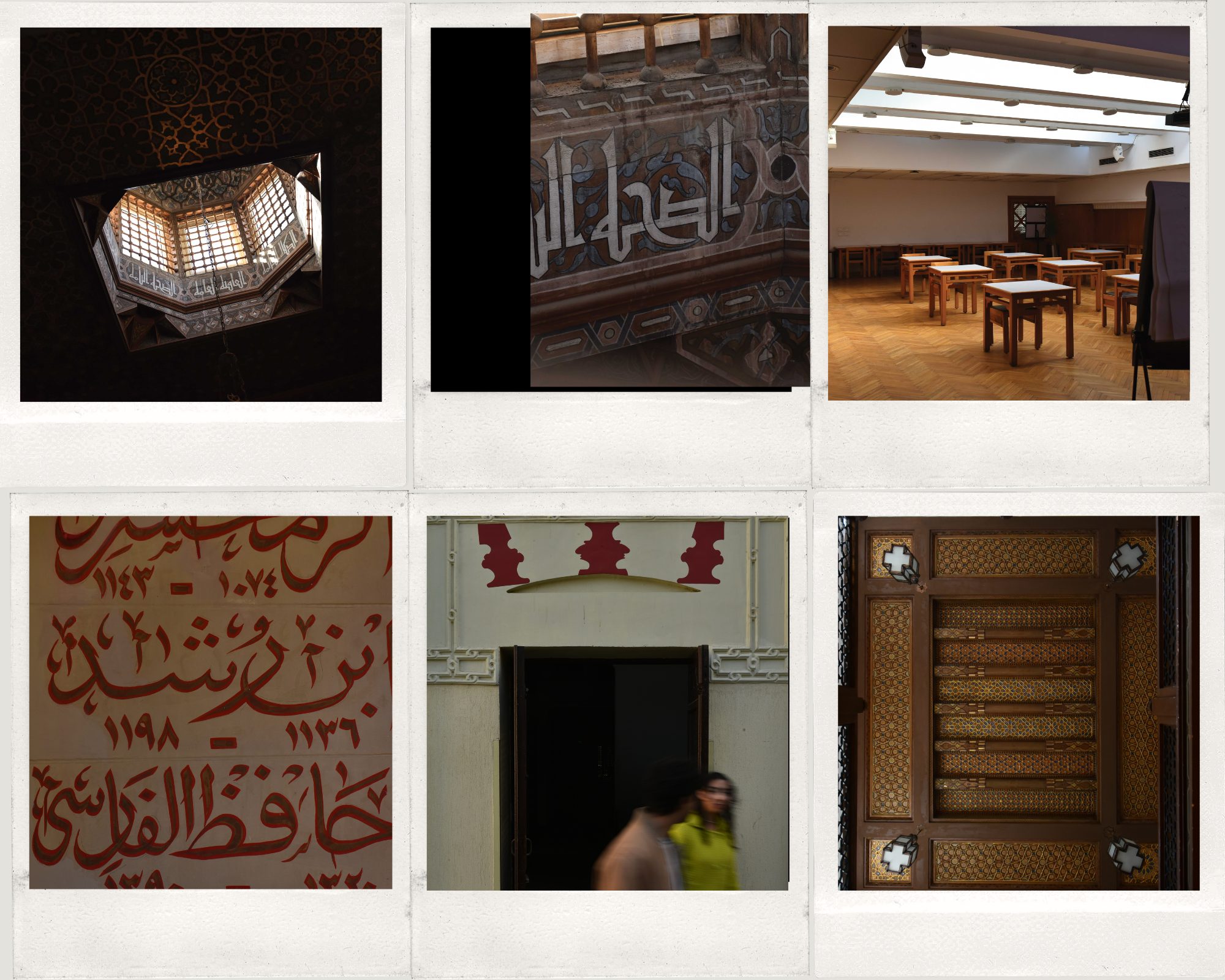
Snippets of AUC's Tahrir Square campus interior
Historically, the Tahrir Square campus mirrors Egypt’s evolution. AUC admitted its first female student in 1928 — decades before many Western universities — defended academic freedom through protests in the 1930s, endured government sequestration after the Six-Day War in 1967 and reopened in 1975 as a pillar of civic and intellectual life. Over the years, it has hosted conferences, festivals and symposiums, turning its grounds into a hub of culture, debate and scholarship.
Jillian Campana, theatre professor and associate dean for undergraduate studies and research in the School of Humanities and Social Sciences, says, “I often bring students for classes in Tahrir. It’s a very powerful thing to be a young person walking around and looking at the storied halls and spaces like Ewart Memorial Hall or Oriental Hall. It’s almost like they’re being held up by all of the people that have come before them.”
Inside the palace, the sound of pens scratching paper fills Oriental Hall as Nina Ellis, assistant professor of English and comparative literature, gestures to the gold-trimmed ceiling. “Notice the light in the room,” she tells her Creative Writing class. “What colors do you see? What textures do you feel? If it’s gold, does it shine? Does it reflect the light?” For Ellis, the campus itself is part of the lesson. “Dazzled is the word,” she says of her first visit. “Which I think must be the intention.”
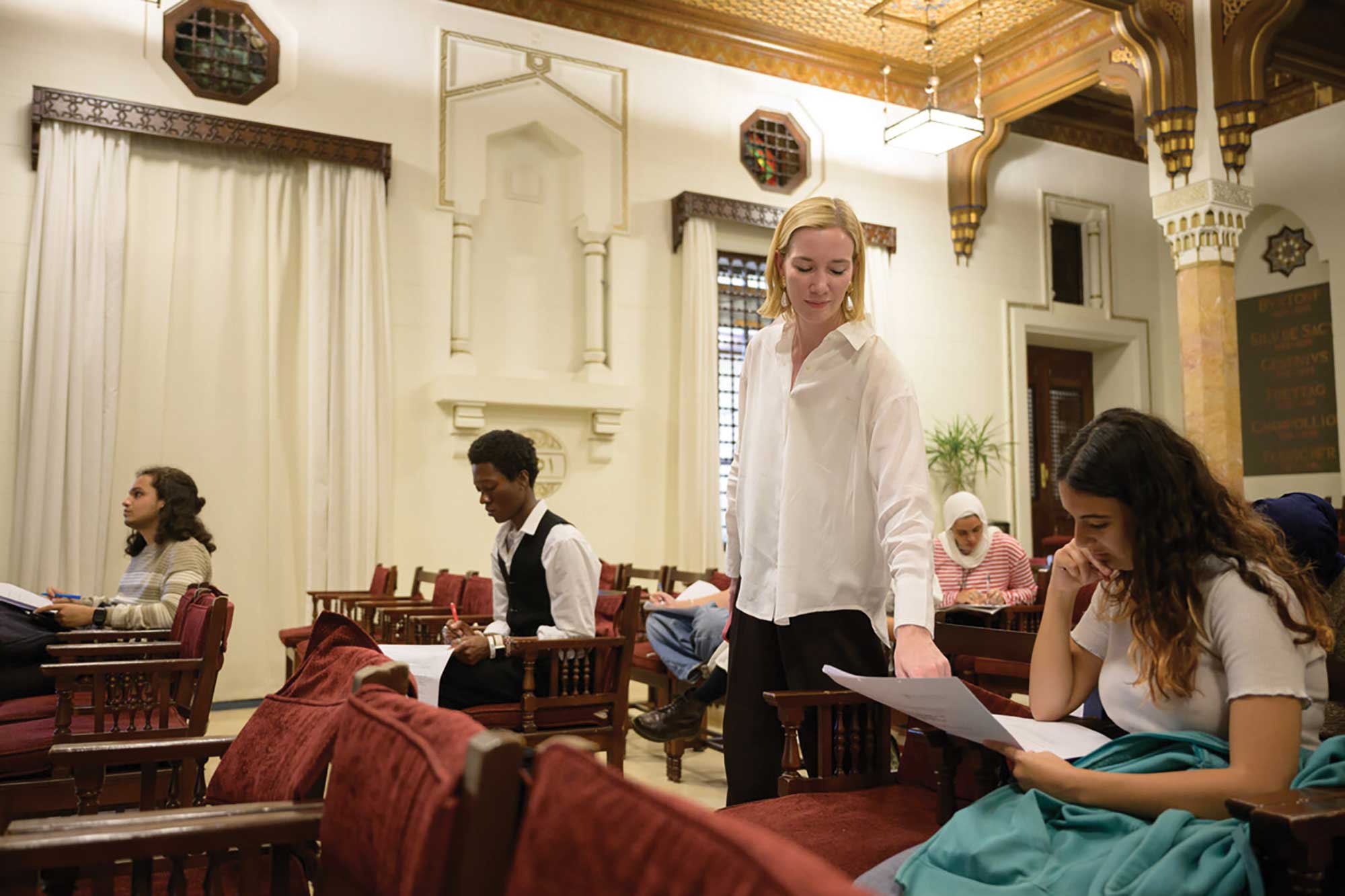
Creative Writing students take inspiration from the surrounding architecture and vibrancy of the Tahrir Square campus
Students in the class use the historic space as a living setting. Psychology sophomore Mazen Massen writes from a balcony overlooking downtown traffic: “I felt my character would gravitate to that, looking at the big picture of all the people.” In Oriental Hall, integrated marketing communication senior Layla Khaleb focuses on “the smell of the wooden chairs, mosaics and glass.”
Built in the 1870s and home to AUC since 1919, the palace has hosted figures such as Helen Keller, Martin Luther King Jr. and Edward Said. Today, it anchors the University’s public and cultural life downtown. “It continues to serve Cairo and the community,” Ellis says. “And I think it’s really important that these students return to this campus. I say return because it is part of the history of their identity as AUC students.”
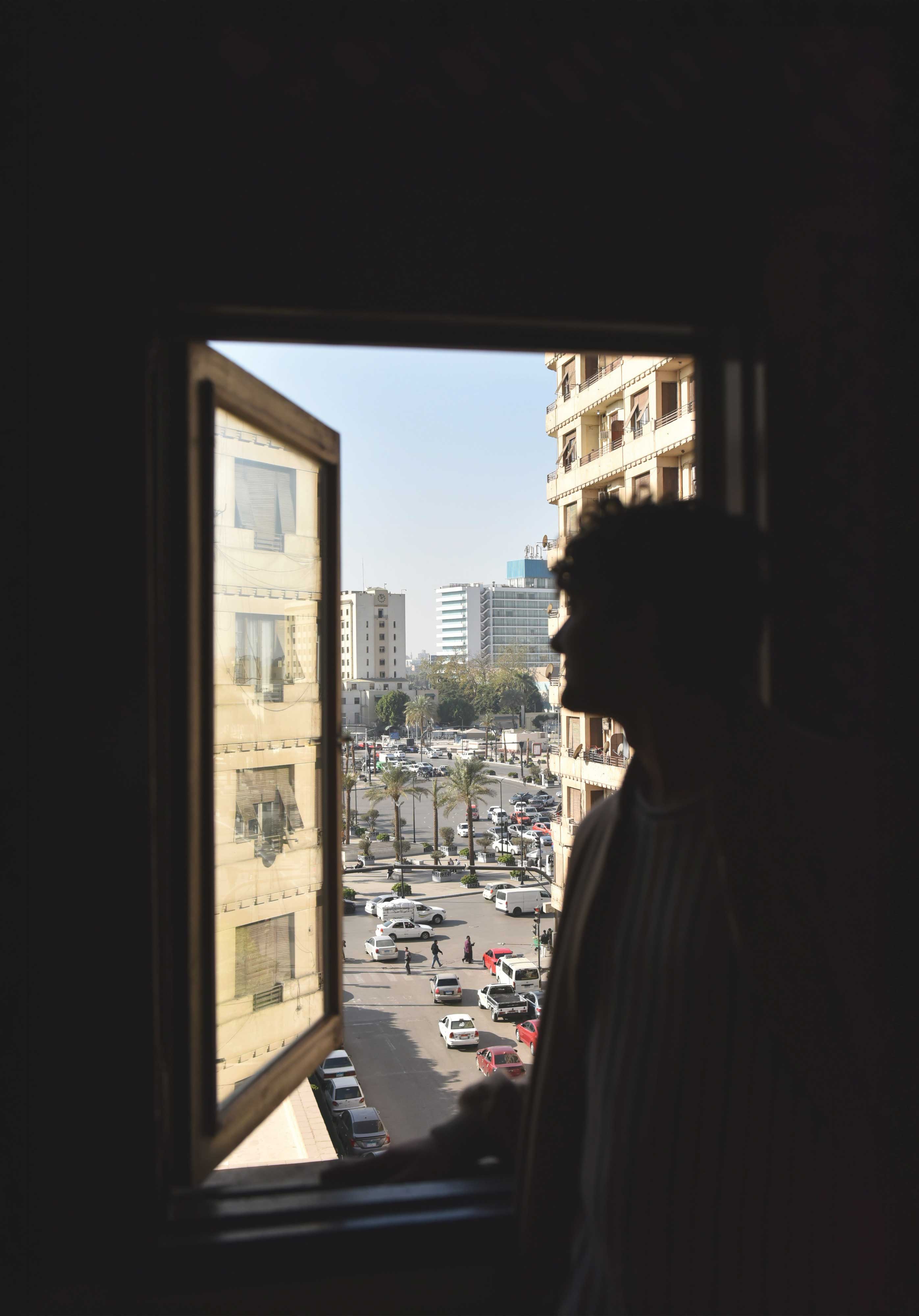
AUC student stands by a classroom window on the Tahrir Square campus, overlooking Tahrir Square
A few weeks ago, I returned to the Tahrir campus, and I couldn’t contain how I felt, so I cried again on the sidewalk. Across the black fence, framed by tall trees, a middle-aged businessman leaned on one leg while talking to another man, carefully spreading black leather conditioner over a dusty shoe. Our photographer tried to capture the Arabic calligraphy on the building’s facade, with a man having breakfast on his balcony to the right. It could have been the perfect cover shot: one foot in the University, full of possibility; the other still rooted in Cairo’s streets, also full of possibility.
Beyond its architectural grandeur, the Tahrir Square campus gives people the space to pause, observe, integrate and feel the pulse of the city. As Dallal says, “Historic Cairo is undergoing a cultural trans formation. We believe in it and we are, at its heart, revitalizing the campus in Tahrir to serve the national ambitions and visions much more efficiently.”
The location of the campus was no accident. “Charles Watson [AUC's founding president] thought about creating The American University in Cairo at the outskirts near Giza by the pyramids,” explains Momen El-Husseiny, assistant professor of architecture and urban design. “However, he realized the importance of getting into the frictions of the city and [the] complexity around its history.” That decision planted the University in the heart of Cairo, where history and city life collide.
Over 100 years of its existence, the campus has hosted extremely important events, lectures and interventions by thought leaders. There are movements that were launched from that campus.
Walking through Khairy Pasha Palace, it’s remarkable to consider all it has held: thousands of memories, victories, heartbreaks and conversations that may have changed countless lives. “Over 100 years of its existence, the campus has hosted extremely important events, lectures and interventions by thought leaders,” Dallal notes. “There are movements that were launched from that campus.” Its high ceilings, intricate woodwork and lush gardens form a mosaic of everyone who has ever learned, taught or loved within these walls.
*Additional reporting by Zoe Carver and Olatunji Osho-Williams