

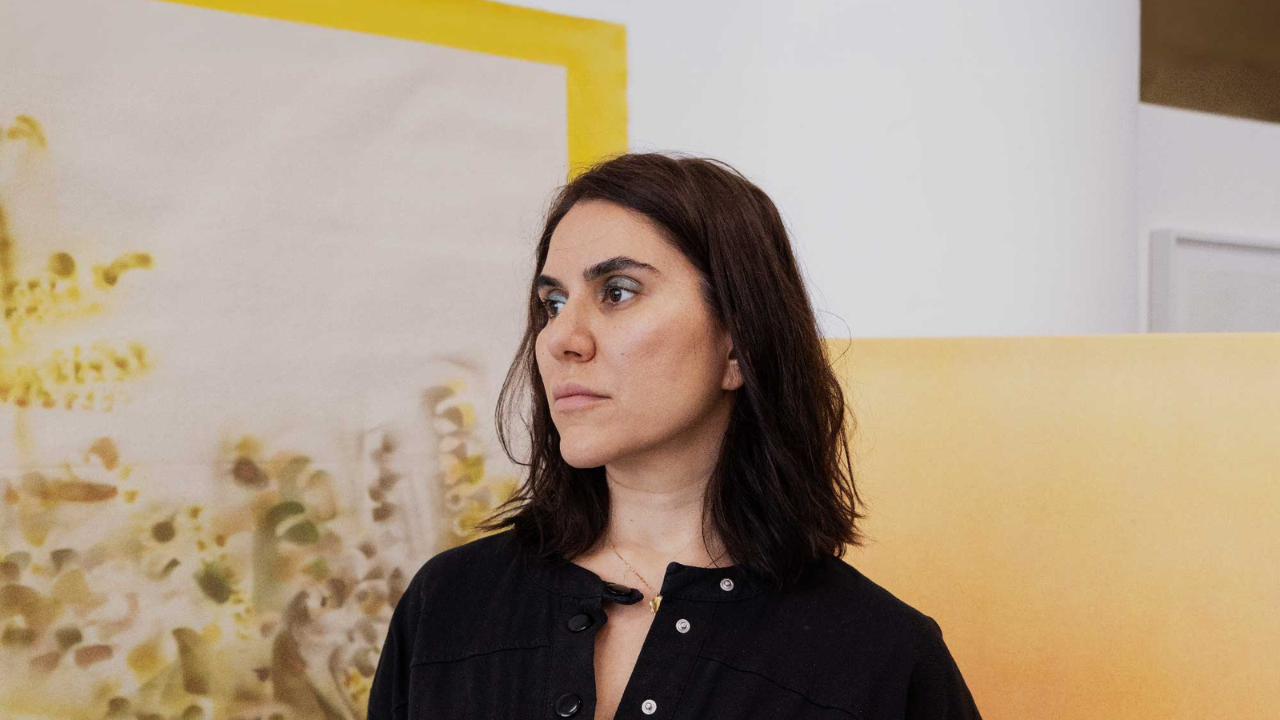
Visual arts faculty Maryam Taghavi brings Persian language and culture into focus through her global work
Maryam Taghavi’s art is traveling around the world, but her creative journey began as she drew with chalk on a backyard wall in Tehran.
“I was making things; I was scribbling. I didn't even know what I was doing, but I was doing things I love,” said Taghavi, associate professor of practice in AUC’s Department of the Arts, who was named one of Newcity’s Artists’ Artists in 2023. Her first solo museum exhibition, Nothing Is, opened at the Museum of Contemporary Art Chicago that year and is currently touring Canada before its final stop in London in 2026.
Nothing Is examines distance: the space between letters, a person and a language; the distance between an individual and a home they know; and the gap between the intention of a word and its received meaning — themes drawn from her life as an Iranian artist living in the diaspora for more than 23 years.
“There are all these things about language that really amaze me, and I really wanted to make art that goes beyond this semantic meaning, something you hold,” she said.
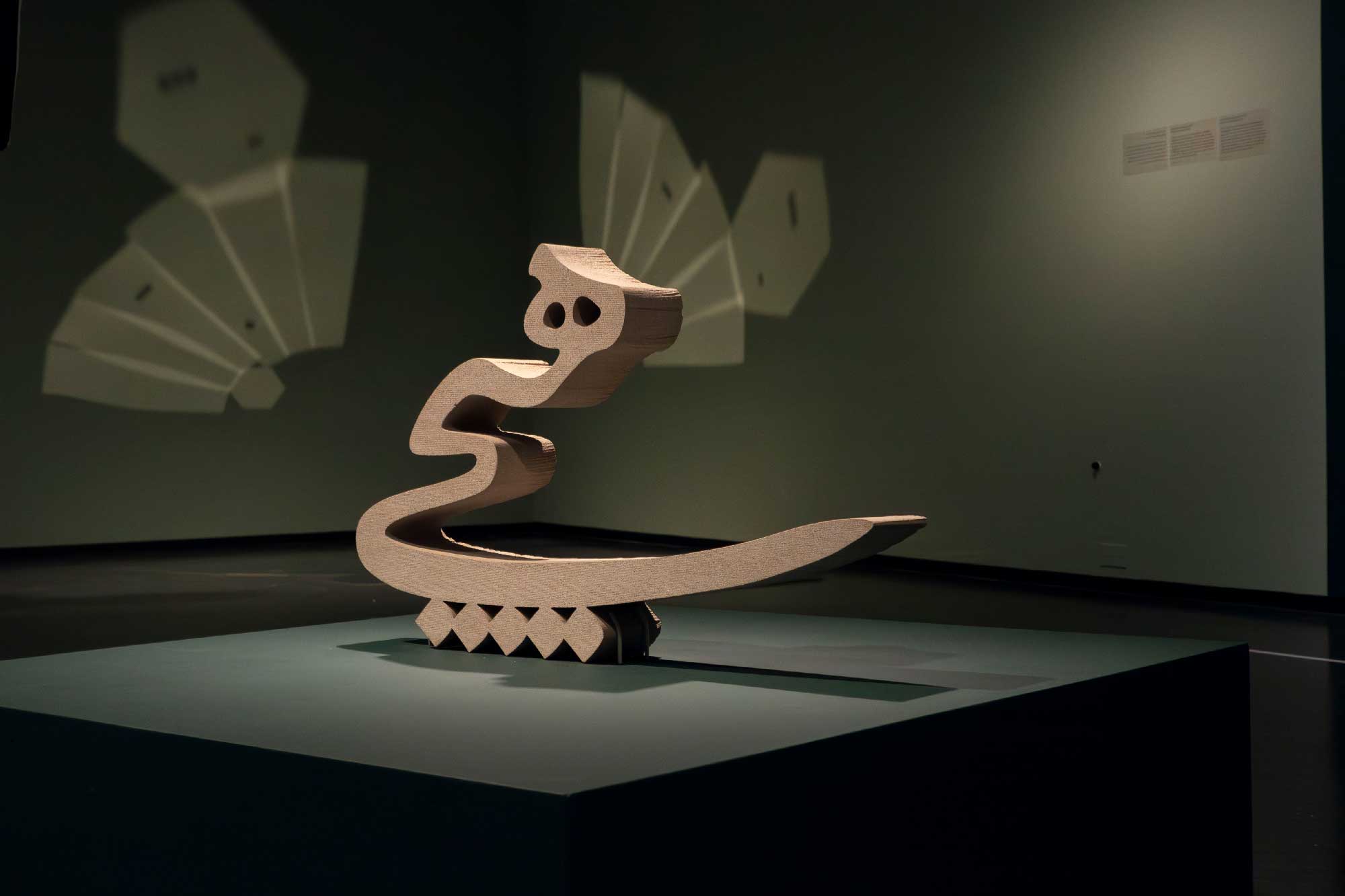
“I’m interested in words and letters as visual forms. They can be read, but they can also be seen, or touched and held as sculptures.”
The Noghte and Nothing
The Persian and Arabic diacritic of the noghte is the thematic center of Nothing Is. Translated as “dot,” the presence or absence of a noghte in Persian script changes the sound of letters, words and sentences. In Nothing Is, Taghavi explores this small diamond shape as it appears in calligraphy.
“I’m interested in words and letters as visual forms," said Taghavi. "They can be read, but they can also be seen, or touched and held as sculptures.”
Taken outside its grammatical context and displayed far from the land where it originated, the noghte takes on new meaning throughout the exhibition. In “Horizon,” a line of noghtes cuts across airbrushed gradients, inviting viewers to consider distance and the vanishing horizon.
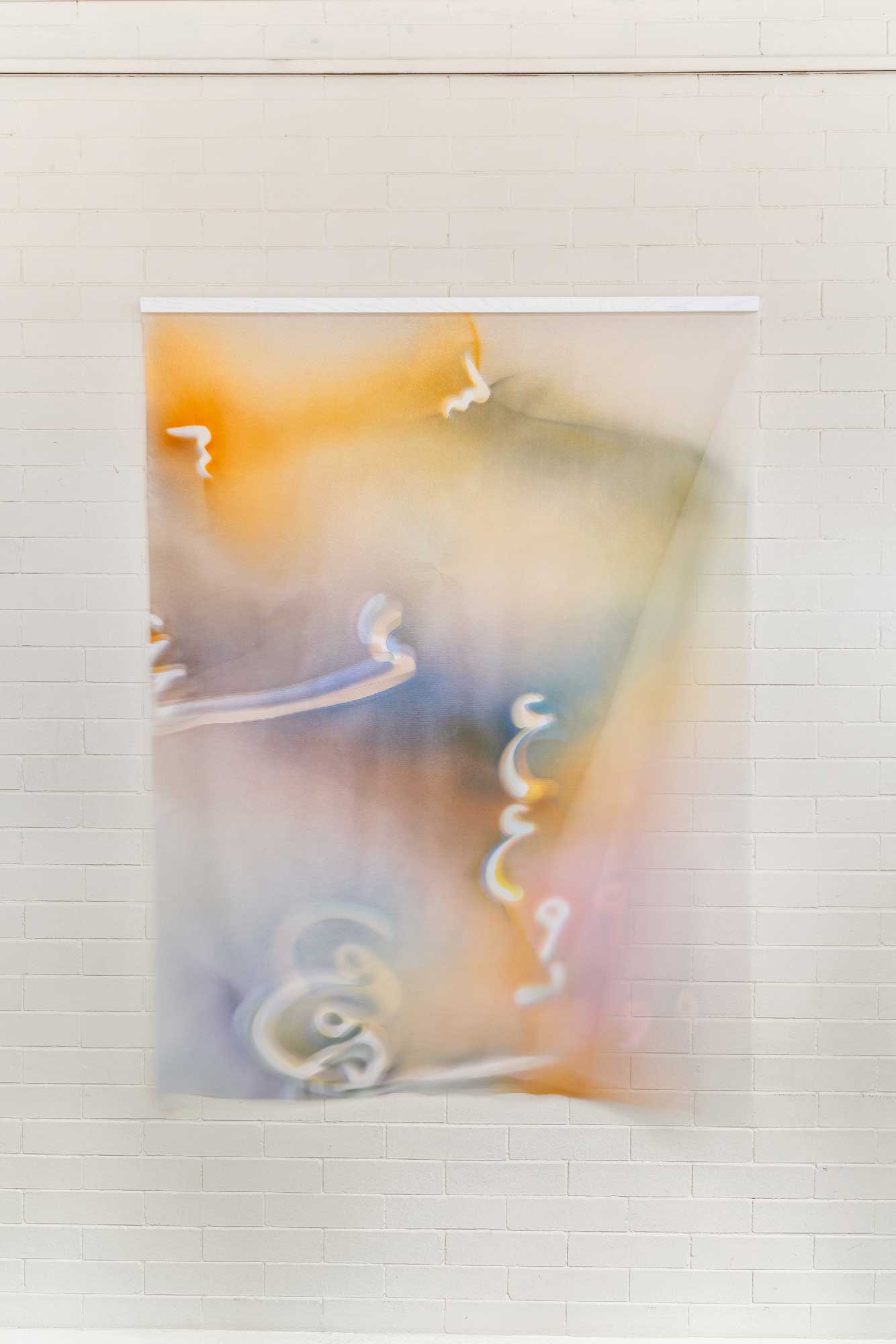
The exhibit also incorporates different aspects of Persian calligraphy, architecture and language. In “Hashti,” the exhibition space transforms into a 12-sided dodecagon, referencing the geometric hashti, or the intermediate space found across Persian architecture.
Consider Taghavi’s “Heechi,” a sculpture of the Farsi word for “nothingness” that references Iranian sculptor Parviz Tanavoli’s Heech series. By transforming heech into heechi, Taghavi shifts its meaning from spiritual fulfillment to emptiness, made tangible in waterjet-cut Indiana limestone.
“I am not practicing calligraphy. I am not practicing this perfection,” she said in her exhibition text. “I am far away from the context that it comes from. I do have this thread to this language, to this culture, but it’s really hard to preserve it. … with the distance that I have from it [and] with the time that we are living in.”
How It All Began
Taghavi grew up in Tehran in a creative household, with a father who sang around the house and a mother who taught dance lessons at home. When her family decided to move to Canada, she faced the possibility of repeating 11th grade.
Knowing this, she convinced her parents to allow her a year dedicated to studying art instead of regular school. She described the experience as pivotal for her growth as a young artist. “This made my commitment deeper to my work. I knew that this is what I want to study, which made me dedicate myself more to it,” Taghavi said. “I remember I was making stacks of drawings when I went to see my teacher. I would always go to the street, cafés and different parts of the city to make sketches.”
Upon moving to Vancouver, 16-year old Taghavi encountered a new physical distance from Iran, the Persian language and now the English she spoke every day. Her interest in calligraphy grew through moments of scribbling in Persian during class at Emily Carr University of Art + Design, with these doodles eventually evolving into larger drawings.
“I think a part of what I was intentional about is to maintain my relationship to reading, to writing, to communicating in Farsi, and even to spending time with certain words,” she said.
Taghavi later earned a Master of Fine Arts from the School of the Art Institute of Chicago, where she would later go on to lecture. Her larger body of work explores how language forms perception through her experience of diaspora.
Having lived in Canada, the United States and now Egypt, distance has never stopped Taghavi from creating art that always finds its way back to questions of home, language and belonging.
Cairo and AUC have provided Taghavi with a new environment to experiment. The innovative work Taghavi continues to develop in Egypt draws on a Persian philosophical tradition that explores the subjectivity and intelligence of plants.
“The city has influenced me a lot. I mean how could it not influence anyone? I think the chaos is making me think things are not as precious, so you just move on. You can’t get too attached to something; you have to keep moving forward,” Taghavi said.