

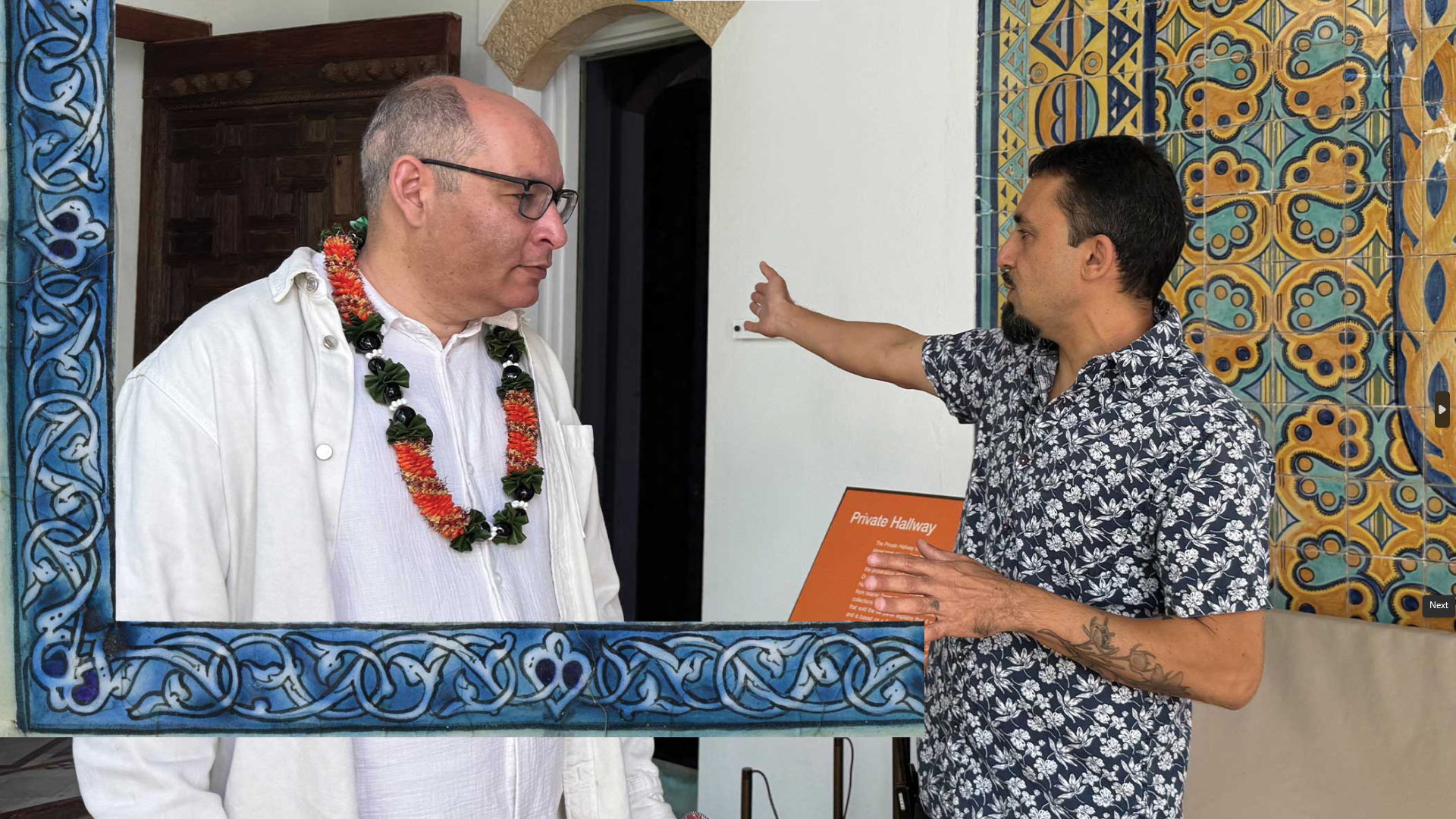
When economics major Seif El Rashidi ’95, ’99 found himself in a class on modern and contemporary architecture through AUC’s liberal arts education, he had no idea his career trajectory would be changing forever. His passion for the history of architecture was ignited, and although he completed his bachelor’s degree in economics, he went on to pursue his master’s in the field of Islamic art and architecture. Today, he serves as the director of the Barakat Trust, a UK-based charity working to preserve cultural heritage from the Islamic world across the globe.
“I was intrigued by art history, especially the idea of tradition and how it evolves,” El Rashidi elaborated on his pathway into the field of cultural preservation. “It was a way of thinking about my own identity through the lens of architecture. Living in England, I’m still very tied to my Egyptian heritage, and it informs much of my work.”
“Our mission is to build the capacity of people with links to the heritage of the Islamic world — to preserve and understand it, and to raise awareness of its importance.”
The Barakat Trust is a grant-giving organization that funds projects to protect, promote and study the art, architecture and heritage of the Islamic world. The organization provides scholarships and conservation grants, as well as offers heritage-based consultancy through its network of experts. “We’re concerned with the Islamic world at large, more than just the Middle East,” he stated.
El Rashidi has worked with everything from the Shangri La Museum of Islamic Art in Honolulu to the Islamic Arts Biennale in Jeddah.
“Our mission is to build the capacity of people with links to the heritage of the Islamic world — to preserve and understand it, and to raise awareness of its importance,” El Rashidi explained. “We provide funding to promote education, create the next generation of preservation experts and ensure equity across developing and established organizations alike.”
El Rashidi reflected on how important it was for him as a young man to have opportunities to work on heritage preservation projects. He worked on the archives of Hassan Fathy at AUC and helped Professor Bernard O’Kane on a project focused on documenting inscriptions in Cairo’s monuments.
Studying in Cairo also had a profound effect on El Rashidi, showing him the ways work in the field can produce meaningful outcomes. “At AUC, the city of Cairo was right outside my door. It was incredible, getting to see the material culture I was studying and meeting people with passion and personal anecdotes about architecture.” He joked, “If it weren’t for these opportunities, I might still be somewhere working in economics.”
Nonetheless, his economic background has come in handy. As the director of the Barakat Trust, having an understanding of business has been incredibly helpful. “I learned all about managing a team while letting colleagues shine and be creative in their own ways. That’s my favorite part of the job: inspiring creativity and finding out-of- the-box solutions.”
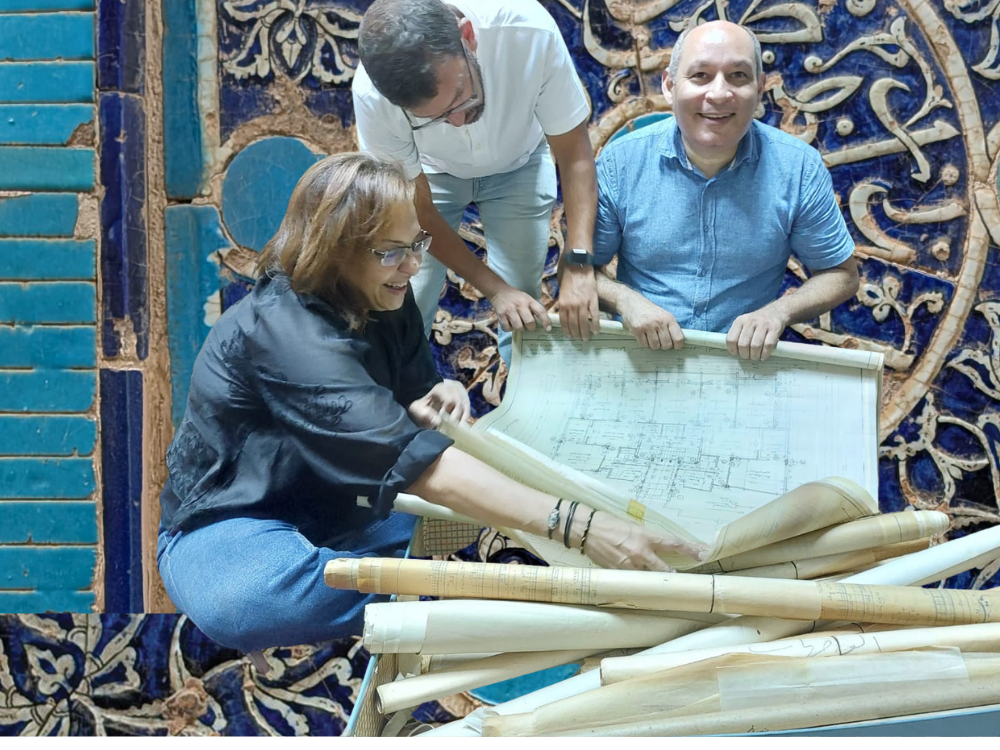
El Rashidi also credits his Egyptian background for helping him navigate the international community. “Being from Egypt makes me resourceful and able to find ways to overcome obstacles,” he shared. “It also gives me an understanding of different government organizations and NGOs operating internationally. I’m able to empathize with many of the obstacles that my colleagues in more challenging environments face. In my role, it’s essential that I understand what it’s like promoting heritage preservation in all contexts.”
El Rashidi hopes AUCians living both in Egypt and abroad will continue to be curious about heritage preservation and the ways to care for culture in a world obsessed with globalization. “Knowledge is important for heritage preservation,” he explained. “Keep being curious and investing in your community. Buy crafts from local artisans, and visit places that are culturally significant. Take random classes on architecture, just like I did. History is a part of everyone’s identity. The best thing you can do for heritage preservation is to understand your own background and traditions, and how they connect to the world around you.”