

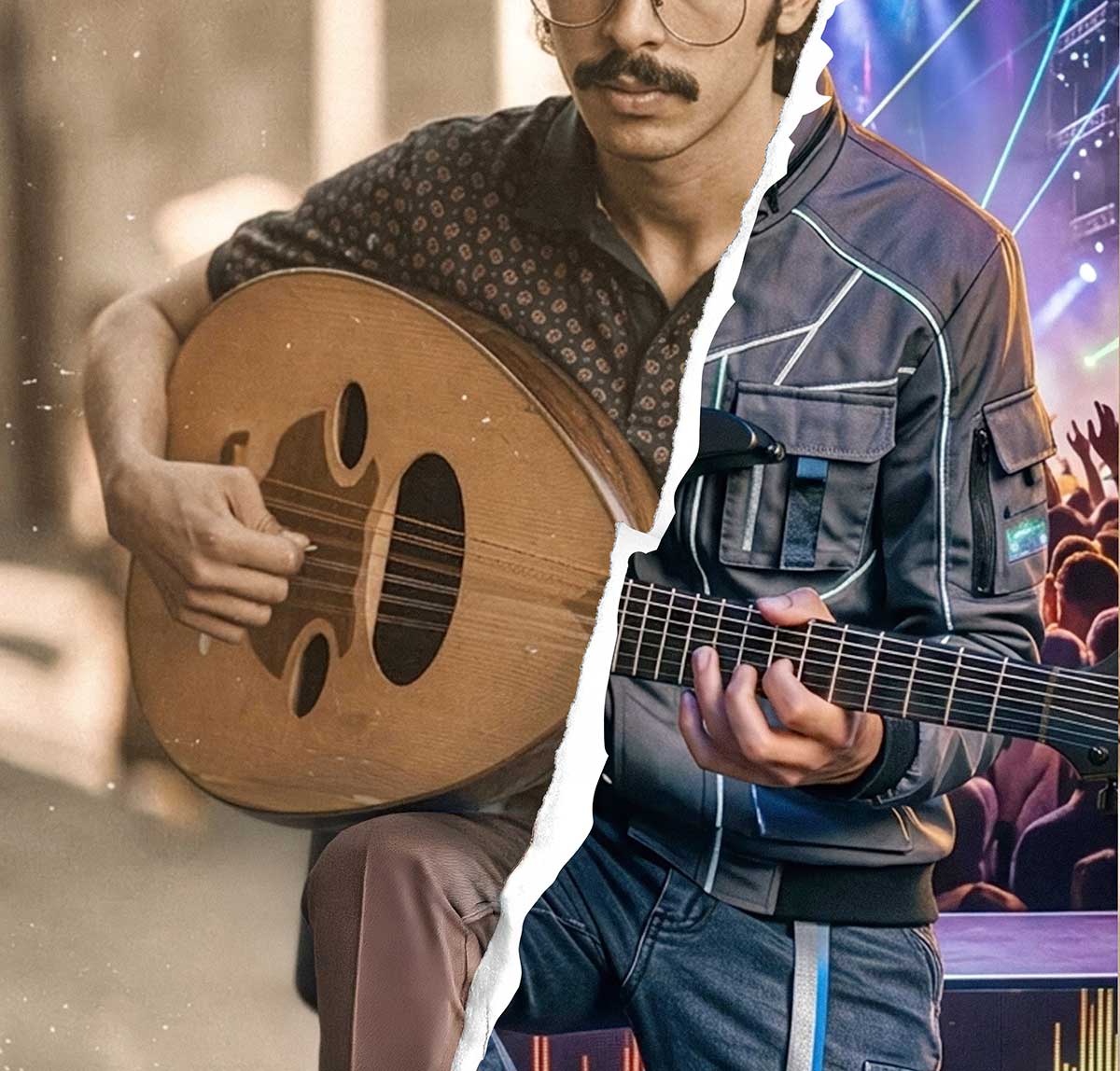
Musicians and scholars at AUC debate innovation and heritage preservation as AI enters Arab music in a rapidly evolving landscape.
There is music in the air at the AUC Tahrir CultureFest. Moments after TEDx panelists discuss artificial intelligence, musicians tune electric guitars and pluck qanuns (traditional Middle Eastern string instruments) on stage.
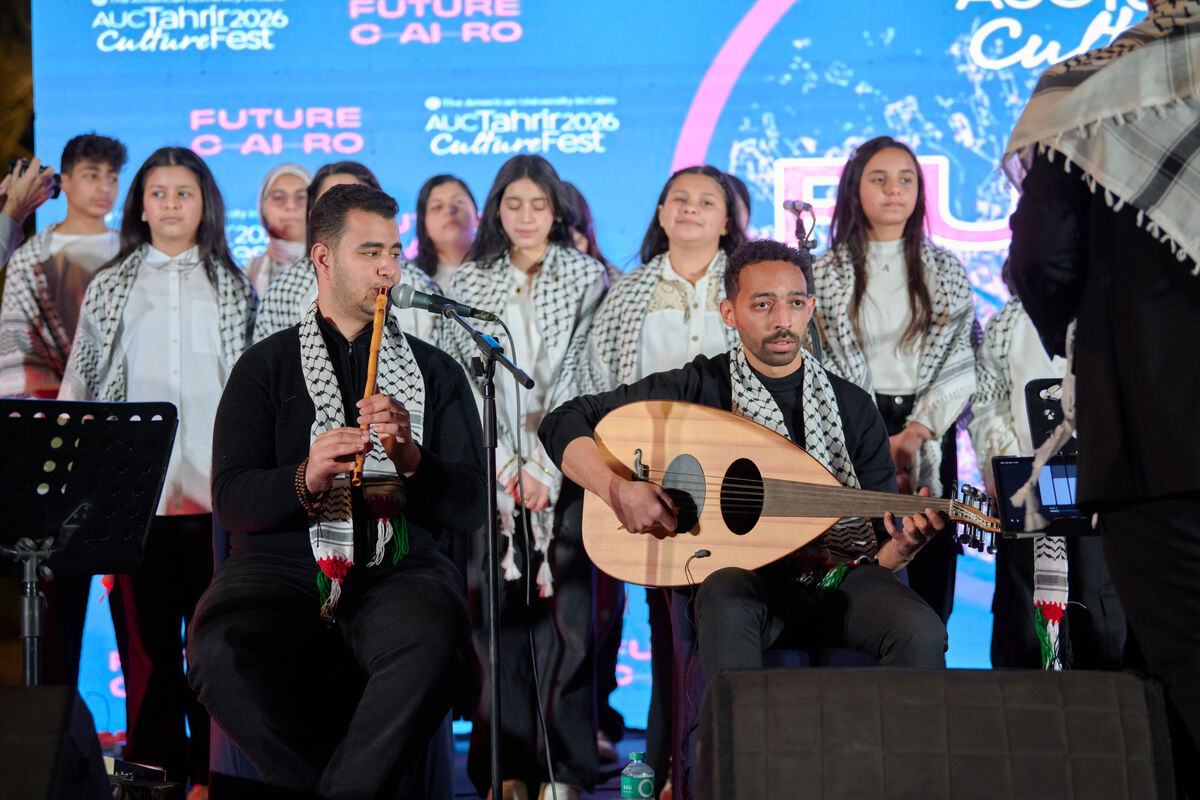
The festival placed artificial intelligence at the center of conversations about the future of Cairo and the Arabic-speaking world. Artists across the region are already experimenting with how the technology can be used in film, television and music.
This Ramadan saw the release of the first fully AI-produced series, Alf Leila w Leila - Hammal Sisan, an adaptation of the classic A Thousand and One Nights. BroadcastPro Middle East reported that AI was also used in the opening sequences of 15 television series in Egypt.
“Now you can’t make generic stuff because AI can do it. Real artists are going to stand out. What they make is different, and AI cannot replicate that.”
Beyond television, AI is reshaping music production. Generative tools such as Suno now allow users to create soundtracks from simple text prompts. In Egypt, composer Amr Mostafa’s December 2025 track “Be3teeny Leh,” featuring artists Ziad Zaza and Moataz Mady, was partly composed using AI tools.
Speaking at the closing performance of the AUC Tahrir CultureFest, Mostafa reflected on the creative role of technology: “If you prompt AI well, it gives something unique. But it’s recycling music you’ve heard before, which makes it familiar,” he said.
That raises a deeper question: How does AI interact with the Arab musical tradition that stretches back to the fifth century?
Artificial Intelligence and the Arab Tradition
As AI continues to transform music creation, Arab music itself has long evolved through layers of cultural and technological exchange. From the Silk Road to the Ottoman Empire, music traditions were developed through movement, trade and adaptation. Today’s mahraganat, or Egyptian street music, emerged alongside synthesizers and global electronic dance influences.
At the core of these traditions lies the maqam system, the tonal backbone of Arab music. A maqam is built from scales, melodic phrases and intervals that carry distinct emotional qualities. Lebanese singer Fairuz sang her 1993 song Ya Rayt Mennon in maqam Bayati, one of the most widely used maqams in Arabic music, often associated with a sense of longing.
"Different performers often changed the maqam and melody of a qasida because what matters are the words and interaction on stage."
Many maqams use microtones — intervals smaller than a semitone. Unlike the 12-tone system in standard music, these smaller pitch variations allow for more fluid melodic expressions. Because the piano is arranged in semitones, with each adjacent pair of keys representing one, it has no key for a quarter tone. Such a pitch would lie between two keys, as if it were an imaginary one.
Fretless instruments such as the oud and rababa allow musicians to move between pitches, unlike standard tuning systems. Similar tonal systems also exist in parts of Asia, as well as in certain European traditions.
Wael ElMahallawy, professor and chair of the Department of the Arts who teaches music technology, qanun and Arab music theory at AUC, noted that music technologies once built on Western systems are increasingly incorporating Arabic maqams and rhythmic patterns such as the tabla percussion. He said this shift reflects growing regional interest.
AI companies are also expanding access to Arab music tools. On February 18, Google DeepMind released the Arabic beta of its Lyria 3 model, which generates short music clips — including customized Ramadan-themed ones — from text prompts.
“Last Ramadan, roughly 50 to 60 percent of TV music was created using AI software,” ElMahallawy said. In a Ramadan mini-series this year, he used AI for backing tracks while performing lead piano and qanun parts himself.
ElMahallawy described AI as a supporting tool rather than a replacement for musical knowledge, warning that without traditional grounding, “the Arab tradition will disappear” if music shifts entirely toward Western models.
Talking Technology
At AUC, ElMahallawy has used artificial intelligence to develop Dokan Bach, an archival project that transcribes difficult-to-find Arabic songs into sheet music. Much of the tradition has historically been preserved orally, from qasidas — epic laudatory poems first performed across the Arabian Peninsula — to renditions by 20th-century Arab music legends like Umm Kulthum.
Before notation systems, qasidas evolved from public recitation into musical performance accompanied by instruments, forming the classic Arab ensemble, the takht.
Over 300 maqams exist across the Arab world, each with distinct traditions. Efforts to unify and document them culminated in the 1932 Cairo Congress of Arab Music, where scholars codified around 70 main maqams. Much of the music that followed remained undocumented.
"Relying on AI to learn the maqam system can make music repetitive over time and lead to a loss of all of your identity, flavor, culture and music."
For ElMahallawy, this is where AI becomes useful. “I use software to write music notation. Now I use Suno or Fader to split the stems so that I can isolate vocals,” he explained.
Within this tradition, improvisation is central. “Different performers often changed the maqam and melody of a qasida because what matters are the words and interaction on stage,” said Ashraf Fouad, adjunct faculty who teaches Music in the Arab Tradition at AUC.
This balance between structure and improvisation continues to influence Arab music today, including how it is being reshaped through digital tools and artificial intelligence.
David Rafferty, associate professor of practice and director of AUC’s music program, said composers have historically been “early adopters of technology,” using it to expand sound possibilities rather than replace them.
Rafferty combines composition with programming to create complex real-time audiovisual systems where sound and visuals respond during performance. Built in coding environments like openFrameworks, the visuals shift in response to live sound manipulation.
The programming is complex, but the introduction of AI has significantly sped up the process. “It’s taken the rate at which I produce this and just — boom, done. I can implement projects faster now,” said Rafferty.
This approach extends into his teaching. In Generative Type Experiments, a weeklong exhibition at the Sharjah Art Gallery, students in the Creative Coding course in the interactive media design minor collaborated with those in Rafferty’s Music Technology class to produce interactive audiovisual works. Design students — taught by Jochen Braun, professor of practice and director of the graphic design program — developed typographic systems, while Music Technology students creating the accompanying sound.
"It’s taken the rate at which I produce this and just — boom, done. I can implement projects faster now."
In one installation Rafferty developed for the exhibition participants manipulated both sound and visuals in real time through phones, creating a responsive, interactive environment. “This is the kind of stuff that AI accelerates,” Rafferty said.
The Future
The impact of artificial intelligence is also a growing worry among students, Rafferty said. “I’m concerned about their future more than anything else because they’re concerned about their own opportunities,” he reflected.
Tolulope Balogun, a music production and recording arts junior at Elon University who is spending a semester abroad at AUC, is a multi-instrumentalist who also produces his own music. He sees AI as a sign of rapid technological progress and believes it will raise the bar for what counts as good music.
“Now you can’t make generic stuff because AI can do it,” he said. “Real artists are going to stand out. What they make is different, and AI cannot replicate that.”
Fouad said technology can enhance human capability when used correctly. “If AI can produce for you, fine, but it should be under your supervision. You have to challenge it. If you let AI lead you, then your mind is frozen,” he said.
ElMahallawy emphasized that AI cannot replace musical knowledge or tradition. “Relying on AI to learn the maqam system can make music repetitive over time and lead to a loss of all of your identity, flavor, culture and music,” he said.