

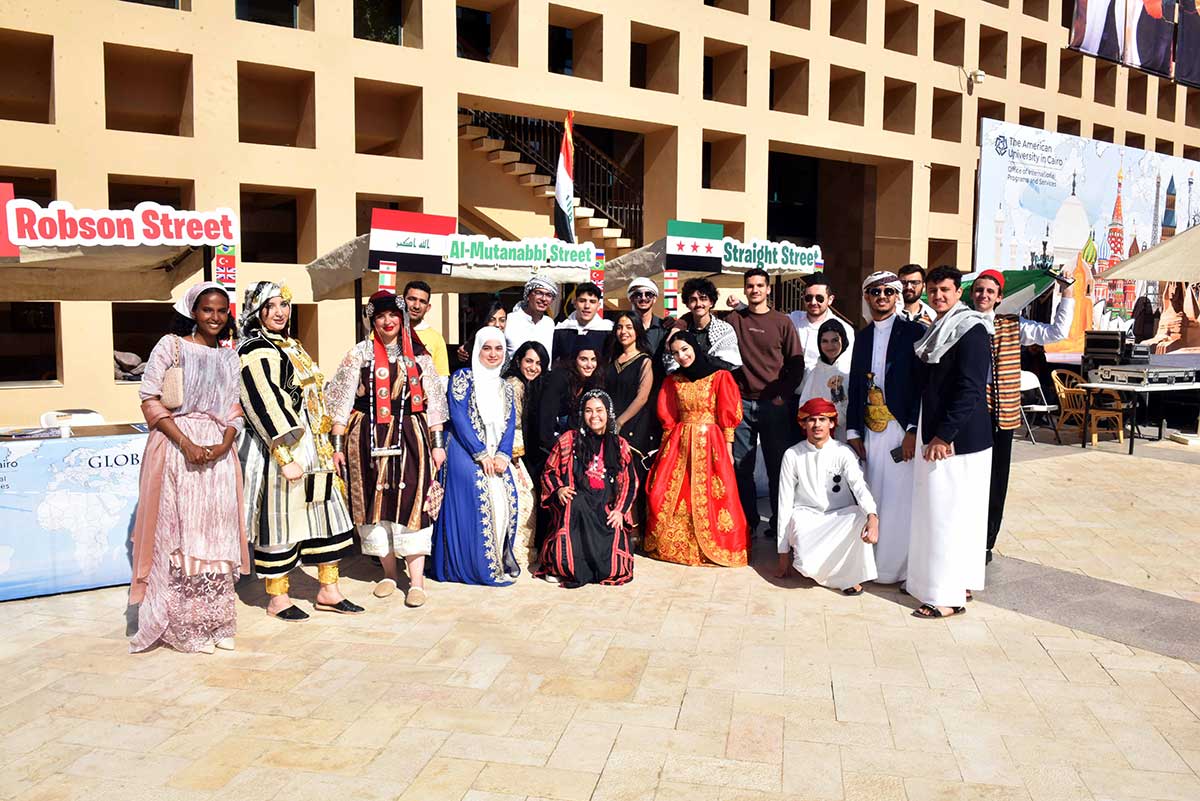
A sandstorm didn’t stop students from parading down Bartlett Plaza in a multicolored train of flags marking the University’s 42nd International Day this year. The annual gathering has celebrated AUC’s diversity since the first festival on December 11, 1984.
"All of them agreed that students of different nationalities would present a little of their culture, traditions and food … to bring everyone a little closer to home, when many are so far away."
Mai Aly documented the preparations for the first International Day in volume 65, no.3 of The Caravan, AUC’s student newspaper. Earlier forms of cultural celebration had taken place on campus as far back as the 1960s and 1970s, when students gathered to share national dress, music and dance.
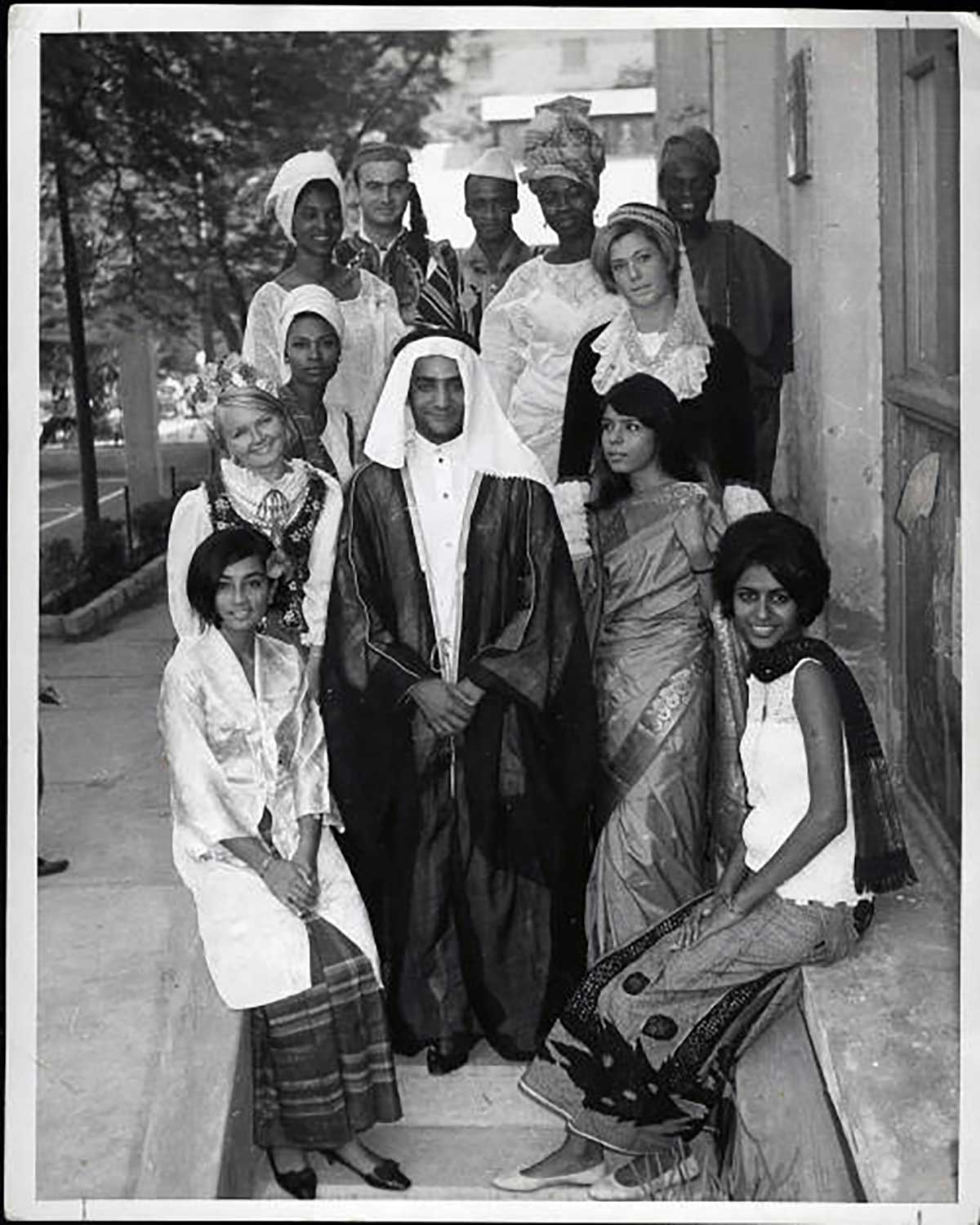
The festival’s initial goal was “to have more integration between Egyptian and international students on campus,” said Cheridan Abdel Kader, then director of International Student Services. An enthusiastic planning committee was created with students from across the globe: Egypt, the United States, Greece, India, Mauritius, Oman, Palestine, Pakistan, Eritrea, Armenia, Turkey and Yemen.
“All of them agreed that students of different nationalities would present a little of their culture, traditions and food … to bring everyone a little closer to home, when many are so far away,” Aly wrote on October 25, 1984.
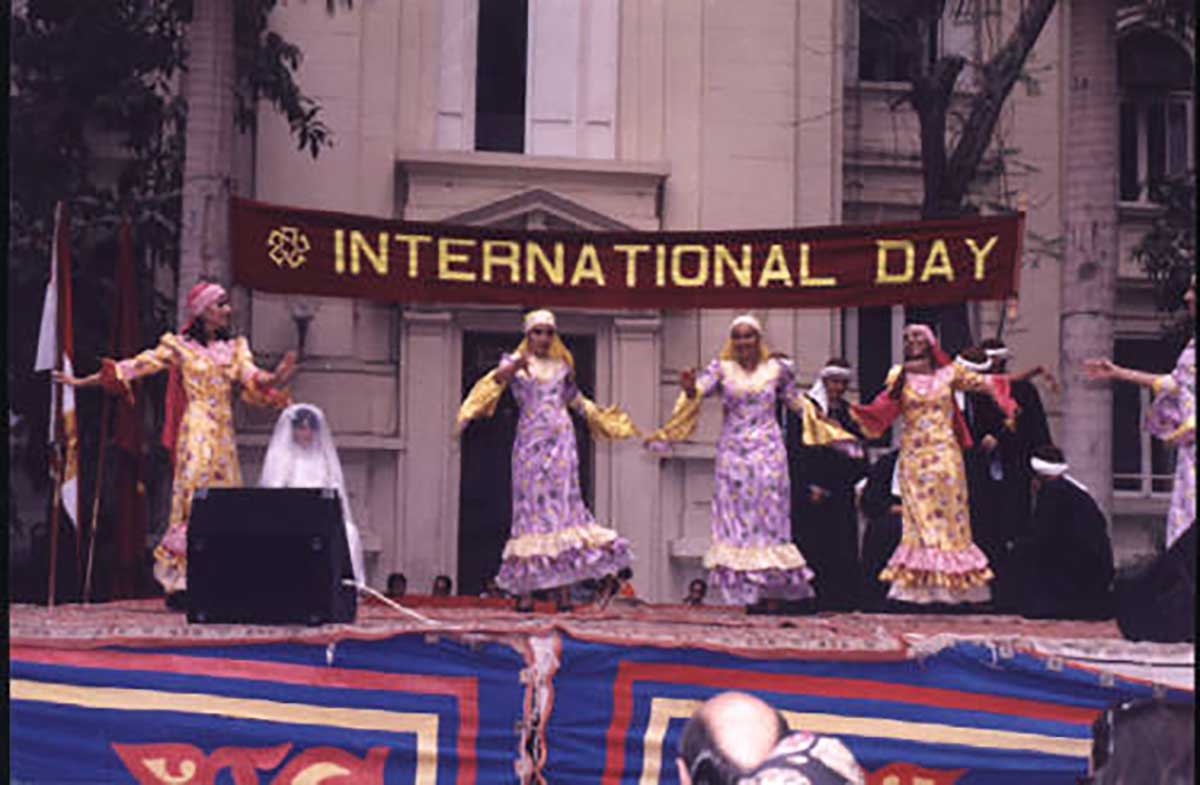
Much like its successors, the first International Day featured students performing traditional cultural dances: “the Greek Zorba, the Lebanese ‘Dabkah’, the Armenian wedding dance or the Egyptian folklore,” wrote Maha Hussein, editor-in-chief of The Caravan, on December 22, 1984.
“The way in which each nation was presented, both at the displays and at the show, made it clear that although we all belong to the AUC community, our real pride comes from belonging to a nation, whether Egypt, Palestine, Lebanon, Greece, America,” wrote Hussein.
Students from diverse cultural backgrounds have been part of AUC since its earliest years, including large Greek and Armenian communities in Egypt, alongside students arriving from abroad. In 100 Years, 100 Stories, author Andrew Humphreys observes the multiculturalism of AUC: “even seventy years ago, with students from as far distant as Brazil, China, Cuba and Indonesia.”
The yearly festival has remained rooted in tradition while gradually expanding to reflect the growing diversity of AUC’s student body. By 1988, the fifth edition of the event brought together 17 countries, with The Caravan writers Mona Eltahawy and Ramy Anis stating that the “most popular dishes were the Egyptian ‘ta’mia’ and the Lebanese ‘shawerma.’”
"The way in which each nation was presented, both at the displays and at the show, made it clear that although we all belong to the AUC community, our real pride comes from belonging to a nation, whether Egypt, Palestine, Lebanon, Greece, America."
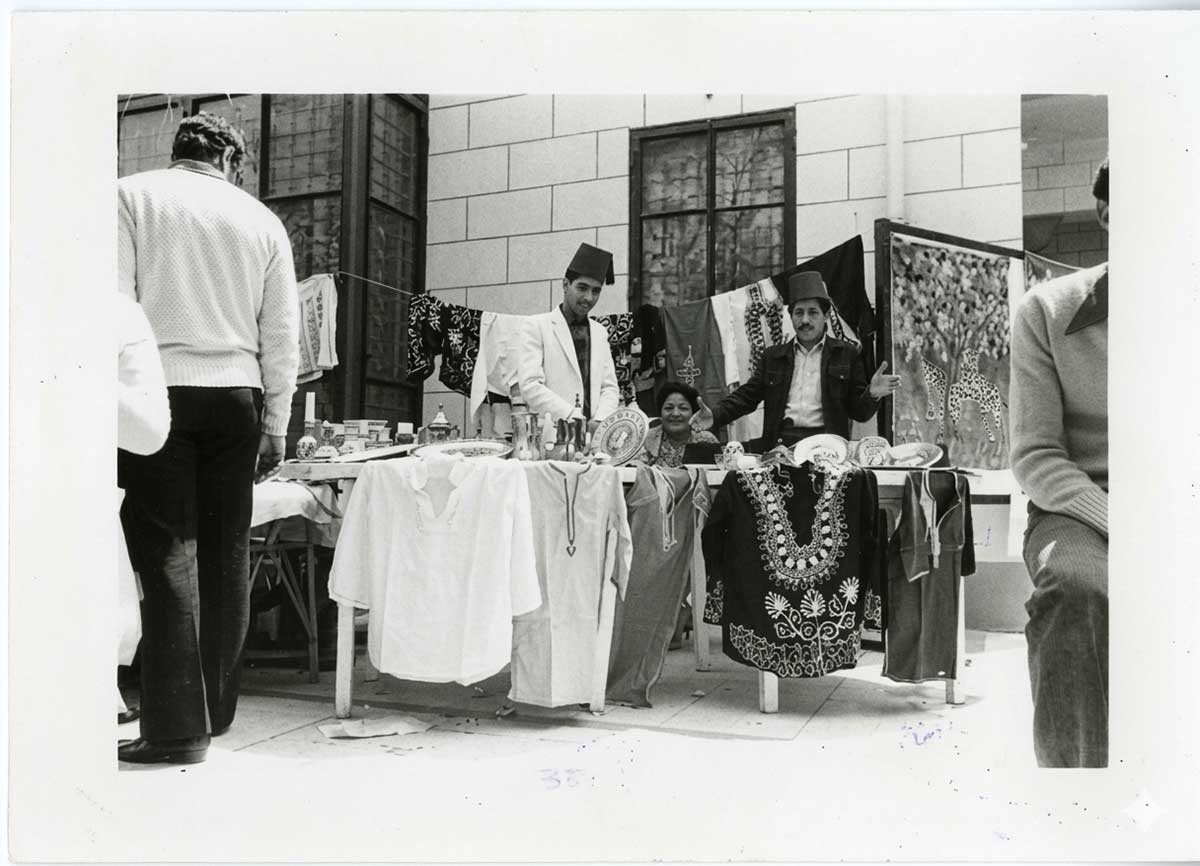
The 10th annual International Day in 1994 brought a crowd of over 60 nationalities. “Lebanon, Iraq, Palestine, Jordan, Yemen, Syria and Saudi Arabia all competed to attract people through their food, posters and the handmade articles they offered for sale,” wrote The Caravan writers Rasha Khalil and Dalia Amin.
Held on May 8, 1994, the 10th International Day coincided with the signing of the Gaza-Jericho Agreement. Caravan Weekly reported that as the Palestinian-Israeli peace accord was being signed that Wednesday morning, “the AUC community was involved in its own efforts towards global integration, with its 10th annual International Day.”
The festival continued to evolve in the years that followed. Horses arrived on campus on International Day in 1996, when the Egyptian booth had a bride and groom on horseback to present a zaffa, or a ceremonial wedding procession.
Later, at the 13th International Day, Richard Tutwiler, former director of the Desert Development Center and later the Research Institute for a Sustainable Environment (RISE), recalled bringing American flavor to campus. “I cooked, flipped hamburgers. That was our American contribution, feeding people hamburgers and hot dogs. It was hard to find any hot dogs, but not too difficult to make hamburgers,” he said in a 2015 oral history.
Nearly 30 years after the first International Day, the 2014 event transformed into a match day with an AUC World Cup theme. The cultural celebration hosted foosball and PlayStation soccer tournaments in anticipation of the 2014 FIFA World Cup. As then student Mohamed Galal put it, “We thought if we can’t go to the World Cup, we’ll have to bring the World Cup experience to AUC.”
The 42nd International Day will be remembered for the sandy weather, but students still connected with one another. Su Huangyi, a master’s student in Middle East studies, participated this year to experience how AUC’s celebration differed from those during his undergraduate years at Peking University.
“It was heartwarming to meet so many AUCians who had been to Singapore before and left with very good impressions of my island home,” he said.
He represented Singapore in this year’s festival and wore a batik shirt — a hand-dyed garment worn in Singapore, Malaysia and Indonesia. Huangyi’s batik was light brown and blue, which he “thought would pair well with the sandy tones of AUC’s architecture,” he said. “But who would’ve expected a sandstorm to make everything even browner?”
For Jena Baitelmal, a Libyan-American freshman studying biology, this International Day was a chance to represent Libya and learn about different cultures. “I thought it would be a good opportunity to meet more Libyans and help share my culture,” Baitelmal said.
As a cornerstone of student life, the role of International Day is best captured in the words of Hussein at the very start of this tradition, describing the aim as an effort for students “to bring their colleagues a little closer to their homes.”