It's a tree! It's a stone! It's a fossil!
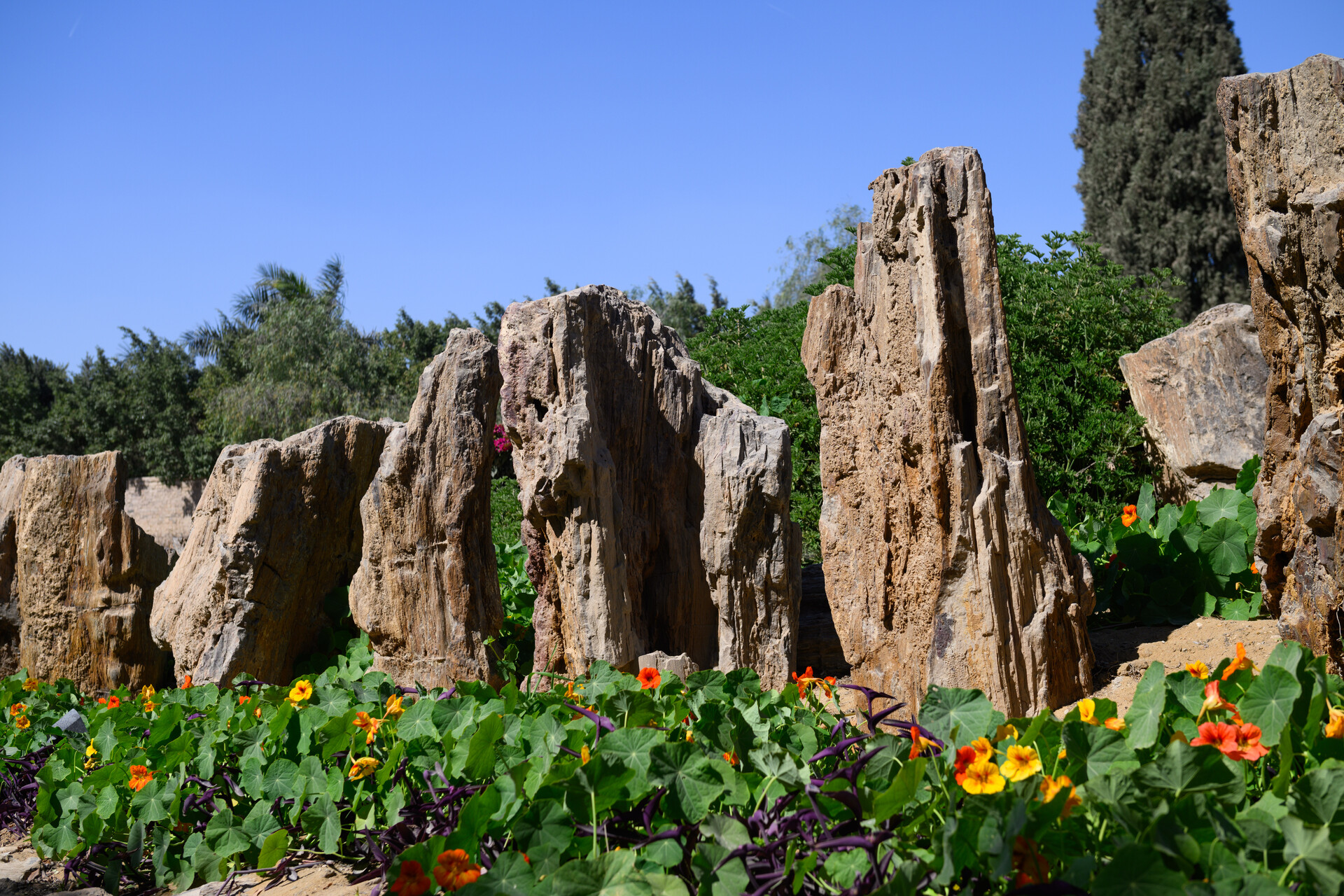
Actually, it's all of the above. "Petrified wood is the fossil of a tree that lived millions of years ago," says Hesham Sallam, professor of vertebrate paleontology in AUC's Institute of Global Health and Human Ecology.
How exactly does a tree turn to stone? Through the process of fossilization, which begins after an organism (like a tree) dies and
is buried in sediment, preventing it from natural decay. "Over time, every single cell in the wood is replaced by minerals," Sallam explains. "In the end, you're left with a rock that looks like a tree."
Scratching the Surface
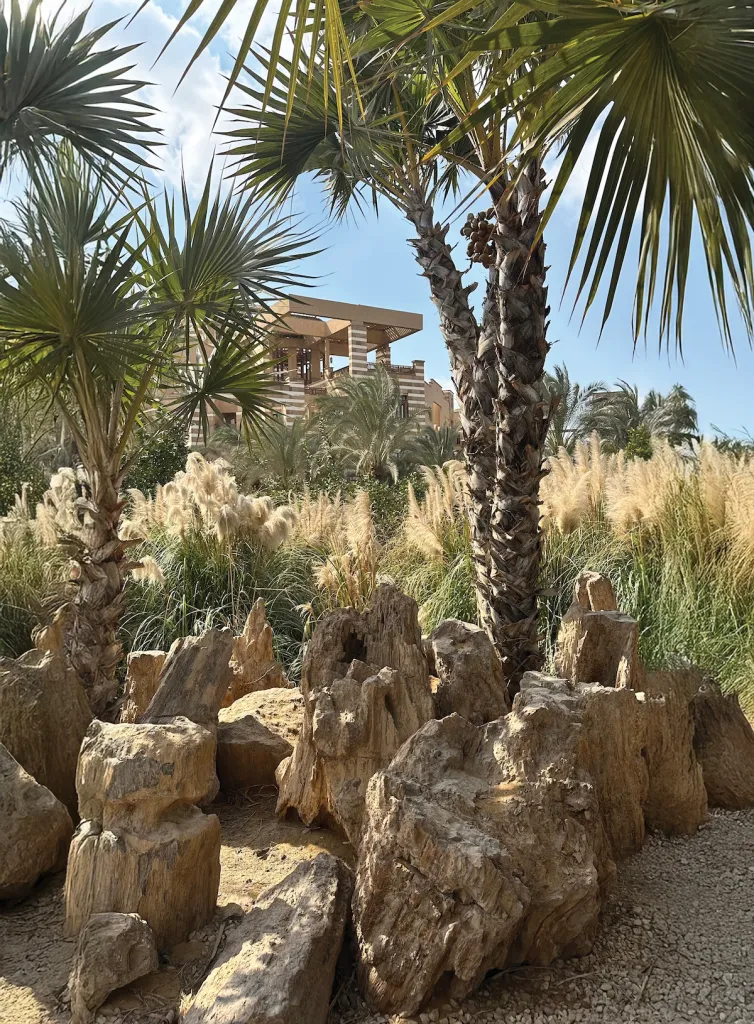
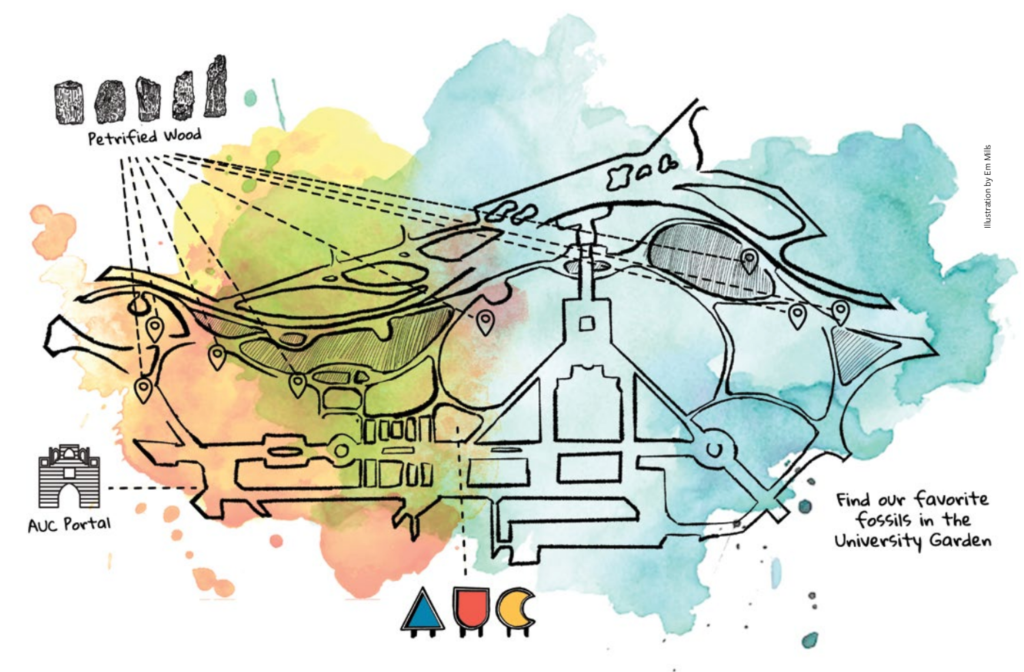
Petrified wood is everywhere at AUC New Cairo. Lining flower beds and walkways in the University gardens and arranged in
eye-catching designs in the parking areas, the rocks blend natural beauty with functionality.
The use of these prehistoric fossils as decorative pieces across the campus is about more than just aesthetics. It is a conscious effort on AUC's part to preserve and protect Cairo's natural heritage. Back during AUC New Cairo's construction, builders were careful to extract and set aside any petrified wood they uncovered while digging the plot for the campus.
Salwa Kotb, director of the Office of Campus Planning, explains: "When we found petrified wood, we stopped digging, carefully pulled the wood from the ground, then photographed, documented and stored it."
With all the extra wood lying around, the planning team decided to use it to beautify the campus. "The collection was repurposed as hardscape elements for driveways, offering a more sustainable solution compared to planting shrubs," Kotb says.
Hidden History
Though undeniably beautiful, the wood also serves as a daily reminder that long ago, Cairo looked a lot different. "Not many of us appreciate that the campus we walk through every day is filled with millions of years of natural heritage," Sallam explains. "These fossils suggest that Cairo was built upon a tropical forest from the Eocene Epoch, dating back roughly 35 million years, when ancient monkeys, primitive elephants and bats were all around."
Eventually, the forest died, collapsed and was covered with dust. "Then the groundwater did its magic, leaving us with the Petrified Forest Protectorate in New Cairo that we have today," Sallam says.
The protected geological heritage site sits a short car ride away from campus, tucked between the sprawling compounds of New Cairo. Established in 1989, the protectorate contains thousands of trunks, some boasting striking deep red patterns and others less commonly adopting an almost-green hue in the sunlight.
"Not many of us appreciate that the campus we walk through every day is filled with millions of years of natural heritage."
"The colors we see in petrified wood represent the minerals that replaced the original plant material in the fossilization process," Sallam explains. "For example, if the surrounding sediments are rich in hematite, an iron oxide mineral, the fossil tends to have a reddish color." Sallam adds that some pieces of wood still contain the fossilized tree's annular rings, which tell us how old it was when it died and fossilization began.
According to Sallam, the wood on campus is just a glimpse of the natural treasures that lie beneath New Cairo's sands. "If we walk out to the garden behind the library right now and start digging, I guarantee we will find more petrified wood," he says.
Sallam often takes students in his Introduction to Geology course to see the wood on campus. "The course includes an entire chapter on fossils and the evolution of life," he says. "AUC's petrified wood serves as an excellent, accessible example for students to appreciate."
-By Devon Murray