

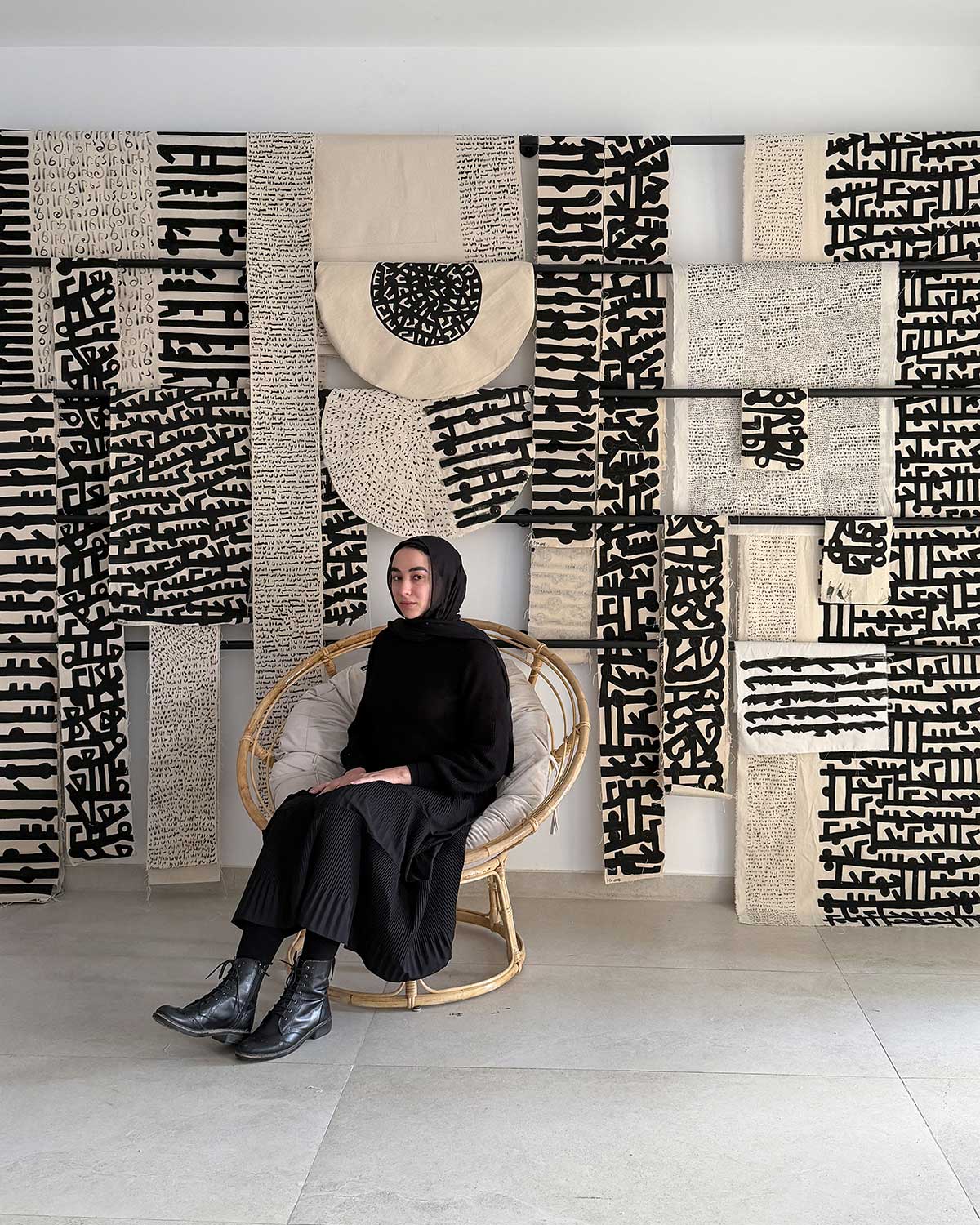
Most often, the way we engage with written text involves finding meaning in a literal sense — simply, what is the author saying? What words have they chosen? What kind of a narrative are they presenting? Graphic designer and lettering artist Mariem Abutaleb ’20, however, chooses to focus on another layer of meaning: the visual form and aesthetics of the language itself.
“I would describe my style as writing that moves beyond readability, transforming into a visual and sensory language meant to be felt rather than read,” she said. “Through black handwriting on paper and fabric, the script changes into form, movement and pattern.”
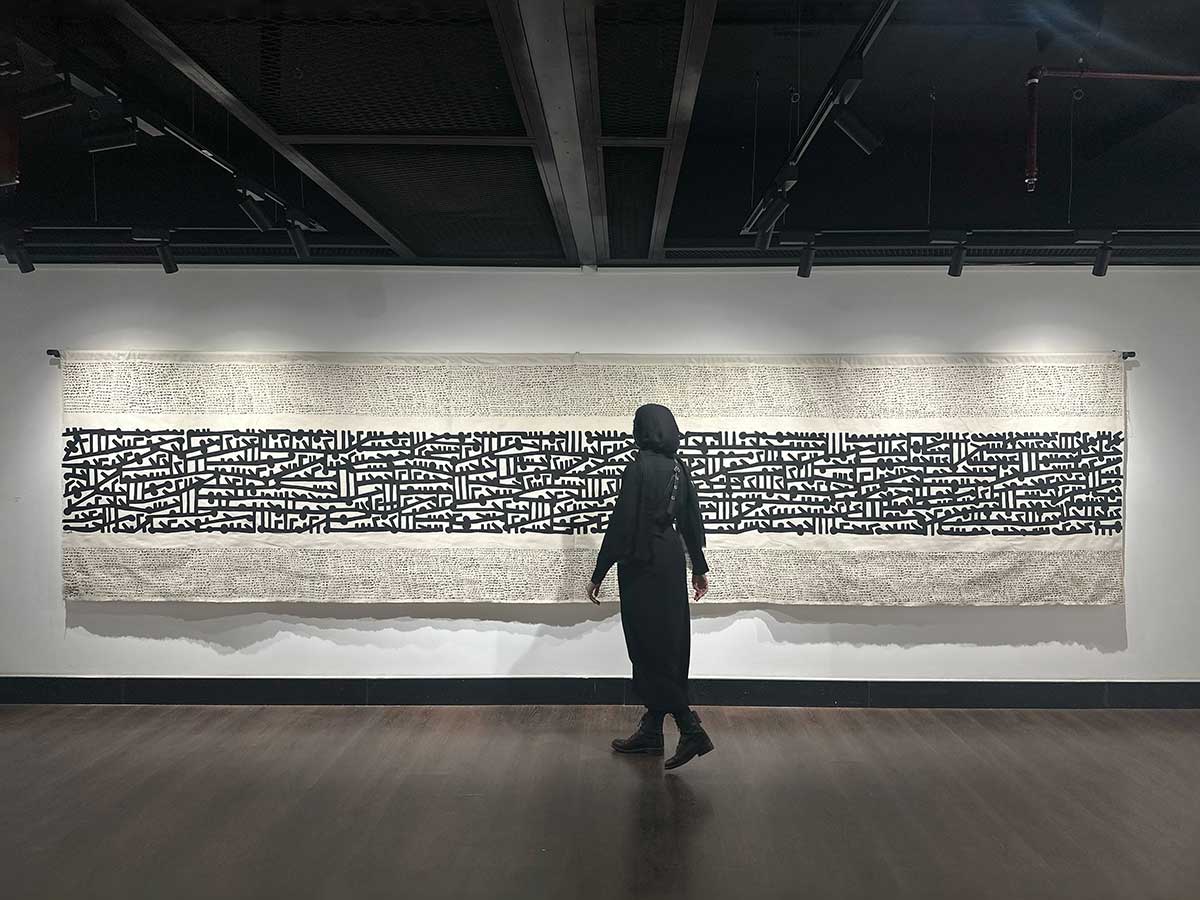
Abutaleb’s designs come from the act of writing itself rather than external inspiration. She begins by holding the brush above the surface and allowing her hand to move freely, building a rhythm while remaining present as the piece unfolds.
“Interestingly, once a piece is finished, I often experience it much like the audience does, as if I am no longer the artist but a viewer encountering it for the first time,” she said. “I approach the work with curiosity rather than certainty. I never try to read what I write, allowing the text to remain a hidden presence that continues to surprise me.”
"Translating my emotions into writing and then seeing them unfolded across large pieces of fabric can feel like an internal dialogue slowly taking shape on the surface."
By not relying on the semantics of the text, Abutaleb’s work becomes open to personal interpretation for any observer, regardless of their ability to understand Arabic. “These moments remind me that art can create meaningful dialogue across cultures,” she explained. In each gallery, viewers might see human heads, animals, snippets of words — none of which were intentionally placed within the work.
“It is especially emotional for me when someone reads a word that is not actually written. It feels as if each person finds something that reflects their own memories, thoughts or experiences,” Abutaleb said.
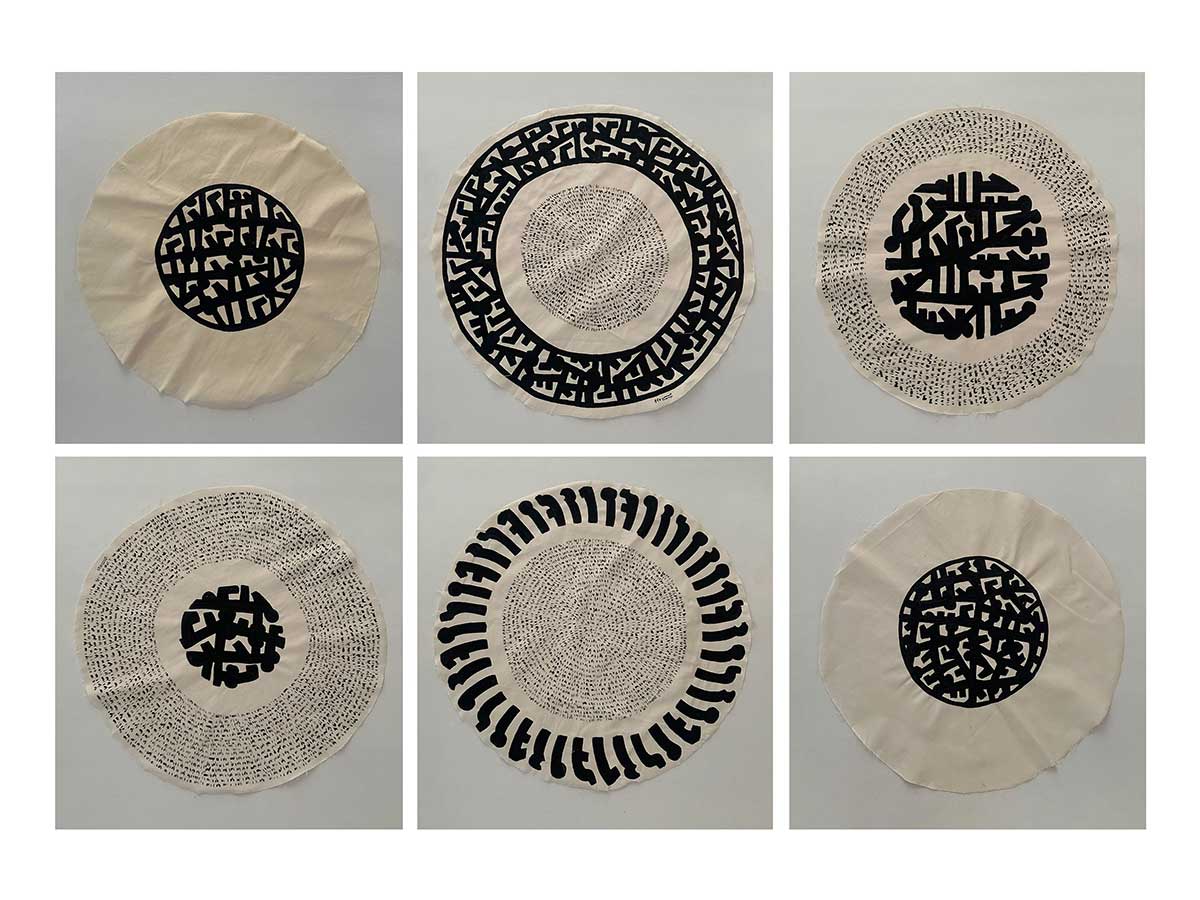
What gives her work its impact is this openness to interpretation and the playfulness of the Arabic script itself — moving away from fixed meaning and instead positioning the script between legibility and abstraction. As she puts it, her work leaves “space for interpretation.”
Rather than arriving at a single reading, her pieces invite viewers to search for it, turning the artwork into a site of shared reading and cultural exchange. A sense of discovery runs through her practice as the work unfolds through experience shaped by what is seen, misread or imagined by both herself and her audience.
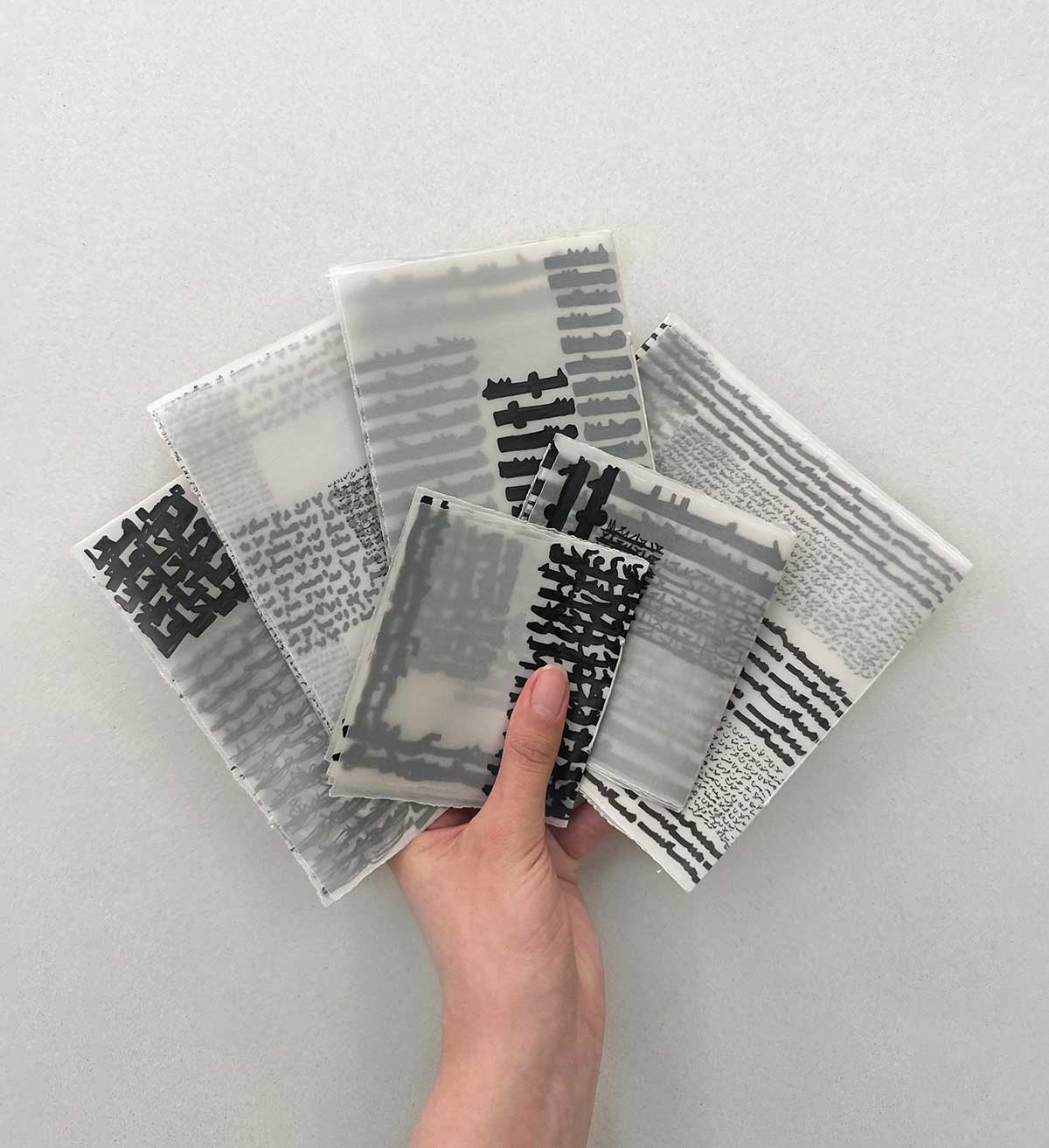
Abutaleb’s work is deeply personal, beginning with handwritten journal entries documenting her thoughts and emotions. From these journals, her artistic practice slowly grew, forming an inseparable connection between her identity and work.
“Translating my emotions into writing and then seeing them unfold across large pieces of fabric can feel like an internal dialogue slowly taking shape on the surface,” she said. “These quiet conversations between myself and my work are often the most meaningful moments.”

Her graduation project from AUC’s graphic design program was a collection of 38 pieces documenting and visually archiving Egyptian folk songs from Sharqiya, her hometown, and Port Said. The project explored the expressive and visual potential of Arabic script and became a turning point in her artistic journey.
“What I learned during my time at AUC helped shape the way I think and approach my work, laying the foundation for the path I continued to explore afterward,” she said.
Encouraging experimentation and curiosity, Abutaleb explained that her studies pushed her to question conventional approaches and embrace different perspectives. “In many ways, that environment helped me trust my own process and gave me the confidence to develop a practice that feels authentic to me,” she said.